Best MVP Development Companies for Startups in 2026 What to Look for and What to Avoid
Most MVPs fail for one of two reasons. Either they are built by agencies who do not understand the product development mindset and deliver a technically correct but commercially useless product. Or they are over-built; the founder wanted to “just launch” but somehow ended up with a 6-month, $60,000 project that is still not live.
The global startup ecosystem funds 60,000+ new ventures annually. Every one of them needs to build something fast and cheap enough to test their hypothesis before the money runs out. The average seed-stage startup budget for their first software build is $8,000 to $20,000. Finding an agency that understands how to build within this constraint without compromising on the specific things that actually matter for product validation is the most important technical decision a non-technical founder makes.
That’s why choosing the best MVP development companies is less about feature depth and more about speed, prioritization, and understanding what truly validates a business idea.
According to Exploding Topics, around 90% of startups fail, with lack of market need being one of the top reasons making rapid MVP validation critical before scaling development. The right development partner helps you test assumptions quickly without overspending or overbuilding.
This guide covers what makes an MVP development company genuinely good at this specific category of work and how to find one for your project.
What an MVP Is and Is Not Getting This Wrong Costs You Everything
The term MVP is the most misunderstood concept in startup technology. Developers hear MVP and build a full-featured product with 30% of the features. Founders hear MVP and imagine a complete product that just happens to be fast to build. Neither is right.
An MVP is the smallest possible product that allows you to test your core hypothesis with real users and get real signals. That is it. Not the simplest version of your full product vision. The simplest product that answers the question you need answered before you invest more.
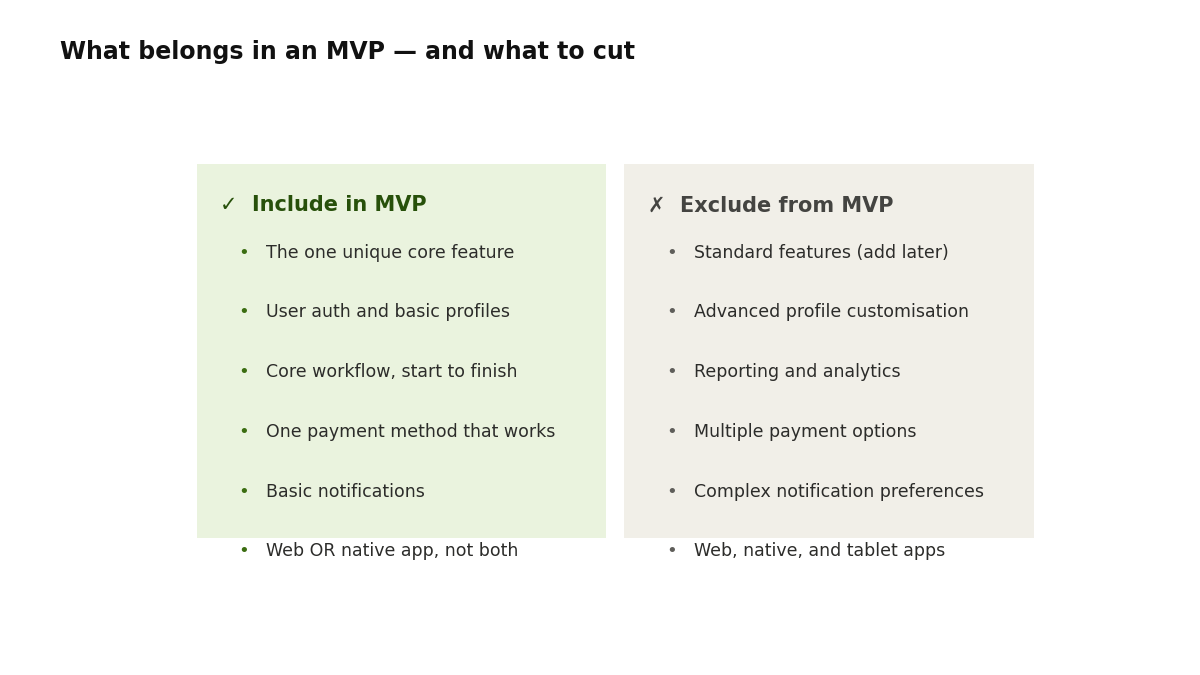
What this means for what you build:
| Include in MVP | Exclude from MVP |
| The one feature that is uniquely yours the reason the product exists | Everything that is standard and can be added later |
| User authentication and basic profiles | Advanced profile customisation |
| The core workflow from first touch to completed transaction | Reporting and analytics (track manually first) |
| One payment method that works | Multiple payment options |
| Basic notifications | Complex notification preferences |
| Error handling that does not crash | Perfect error messages |
| Mobile-responsive web OR a native app not both | Native app AND web AND tablet |
The most expensive MVP mistake is building for scale before proving demand. Authentication does not need to support millions of users. The database does not need to be sharded. The infrastructure does not need auto-scaling. Every hour spent on scalability before product-market fit is an hour not spent on the feature that creates product-market fit.
What Makes an MVP Development Company Good at This Specific Work
General software development agencies can build MVPs. MVP specialists build better MVPs, faster, for less money because they have built 50 MVPs and have operational knowledge of what to cut, what to keep, and where the most common mistakes happen.
The characteristics of a strong MVP development company:
| Characteristic | What It Looks Like | What a Generic Agency Looks Like |
| Opinionated about scope | They push back on features that do not serve the MVP hypothesis | They accept every requirement without challenging it |
| Rapid iteration mindset | First working version in 3–4 weeks, then iterate | “We’ll deliver everything at the end of the timeline” |
| Standard tech stack | React + Node.js + PostgreSQL + AWS boring but proven | Proposing a novel architecture that “scales better” for an unproven product |
| Honest about what $10K builds | Clear scope for clear budget, no padding | Vague scope and “we’ll figure it out as we go” |
| Post-MVP thinking | They ask how you will know the MVP succeeded and what you will build next | Focused only on delivering the current spec |
| Founder-accessible senior engineer | Founder can call or message the lead developer directly | All communication through an account manager |
The portfolio signal to look for:
The best evidence that an agency is genuinely good at MVP development is a track record of MVPs that went on to raise funding, acquire real users, or evolve into full products. Not just “we delivered on time” that is table stakes. “We built a fintech MVP in 8 weeks for $12,000, the founder raised a $500K seed two months after launch, and we built the V2” that is the signal.
Ask specifically: of the MVPs you have built in the last 2 years, how many have gone on to raise a funding round or generate paying users? The answer is revealing.
The Right Tech Stack for an MVP Why This Matters More Than You Think
Technical debt from an MVP is the most common reason startups need a full rebuild 12 to 18 months into their growth. The agency that built the MVP used a technology that made development fast but made scaling painful. Or they made custom architecture decisions that make the codebase incomprehensible to any developer who was not there when it was built.
The MVP-safe tech stack in 2026:
| Layer | Recommended | Why |
| Frontend web | React or Next.js | Massive talent pool, component libraries, easy handoff to future devs |
| Frontend mobile | Flutter or React Native | Cross-platform iOS and Android from one codebase at MVP budget |
| Backend | Node.js (Express/Fastify) or Python (FastAPI) | Fast to build, huge community, easy to find developers later |
| Database | PostgreSQL | Relational, proven, hosted services everywhere (Supabase, RDS) |
| Authentication | Auth0, Supabase Auth, or Firebase Auth | Don’t build auth from scratch ever |
| Payments | Stripe | Standard, well-documented, everything else is regret |
| Hosting | AWS or Vercel/Railway | Scalable, standard, easy to hand off |
| File storage | AWS S3 | Standard. Anything else is unnecessary complexity |
The red flag equivalent: an agency proposing a custom microservices architecture for your MVP is either incompetent (microservices do not make sense at MVP scale) or padding scope to justify a higher quote.
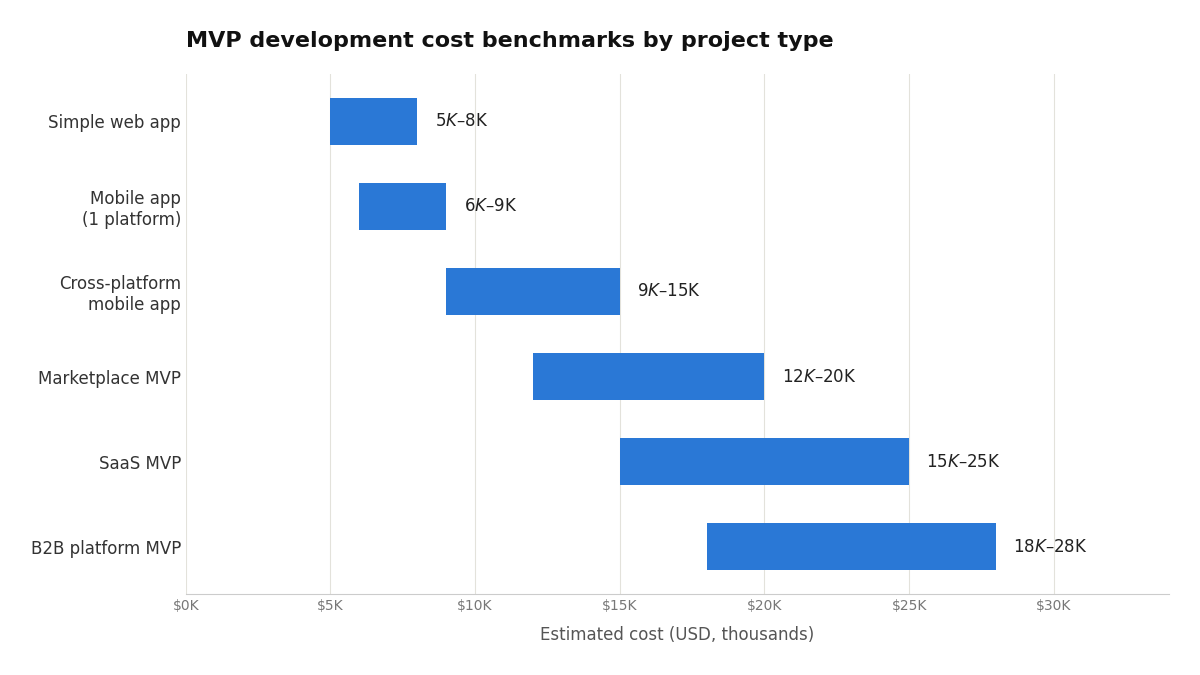
Cost Benchmarks What Your MVP Budget Realistically Builds
MVP cost by type with Indian development team (the standard GetProjects.ai recommendation for $5K–$30K budgets):
| MVP Type | Core Features | Cost Range | Timeline |
| Simple web app | User auth, CRUD operations, 1 workflow, basic admin | $5K–$8K | 6–10 weeks |
| Mobile app (one platform) | User auth, 5–8 screens, 1 API integration, basic push notifications | $6K–$9K | 8–12 weeks |
| Cross-platform mobile app | User auth, 8–12 screens, 2 integrations, iOS + Android | $9K–$15K | 12–18 weeks |
| Marketplace MVP | Two user types, listing/booking flow, payment integration, basic messaging | $12K–$20K | 16–22 weeks |
| SaaS MVP | Multi-tenant, user auth + roles, core feature set, subscription billing, basic analytics | $15K–$25K | 18–26 weeks |
| B2B platform MVP | Company + user model, workflow automation, integrations with 2–3 business tools, reporting | $18K–$28K | 20–28 weeks |
What is not in these estimates:
UI/UX design is separate and costs $2,000 to $4,000 for professional mobile/web designs. Logo and brand identity are separate and add $500 to $2,000. App Store submission prep and accounts $125 in fees. Post-launch infrastructure $80 to $200 per month.
The Engagement Model Fixed Price vs Time and Material for MVPs
For MVPs specifically, the fixed price vs time and material debate has a clear answer: fixed price, with one important caveat.
Fixed price is right for MVPs because scope discipline is a feature, not a limitation. The agency that quotes a fixed price for a defined MVP scope and sticks to it is doing you a favour. They are preventing scope creep. The founder who adds “just one more feature” every week is the founder who spends $30,000 on an MVP that takes 9 months.
The caveat: fixed price only works when the scope is genuinely fixed. A 2 to 3 page functional specification: what each screen shows, what each button does, what data is stored is the minimum required for a reliable fixed price quote. Without it, the “fixed price” will have a change request for every requirement that was ambiguous in the brief, and you will end up paying time-and-material rates with the administrative overhead of a fixed price contract.
The recommended process:
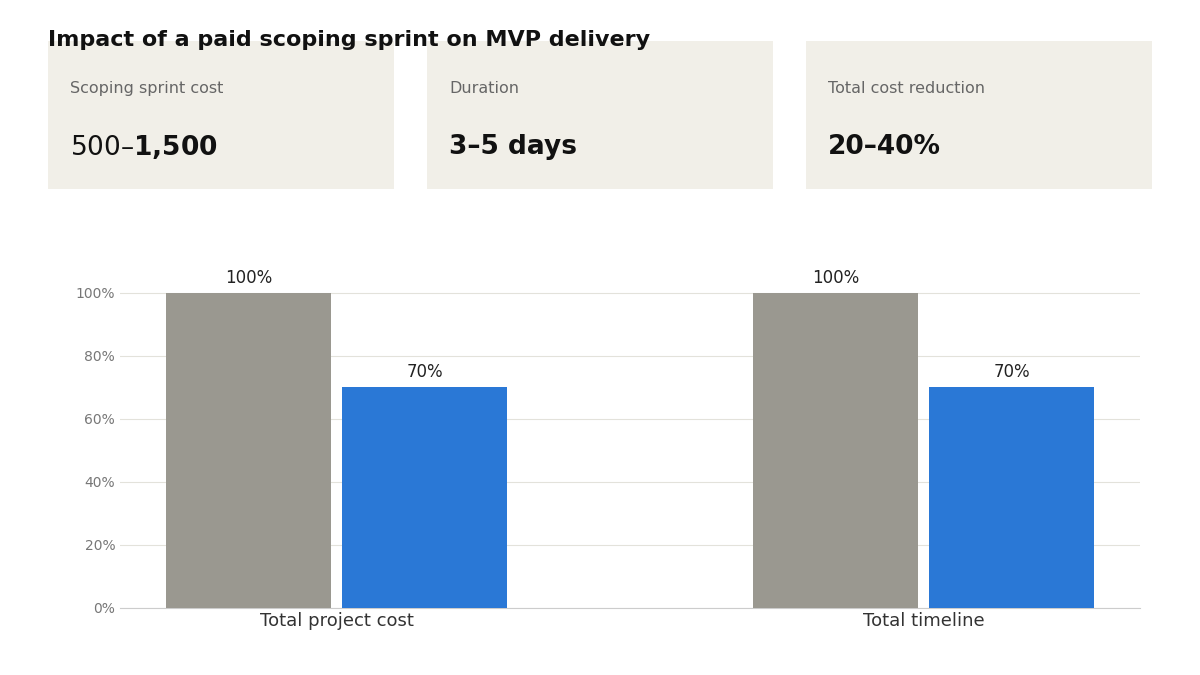
Pay for a scoping sprint first $500 to $1,500 for 3 to 5 days of discovery work with the agency. They review your requirements, ask clarifying questions, identify gaps, and produce a functional specification and fixed price quote. This investment in scoping reduces total project cost by 20 to 40% and timeline by a similar amount by eliminating ambiguity before development begins.
Frequently Asked Questions
What is the difference between an MVP and a prototype?
A prototype is a non-functional or partially functional representation of a product, typically a design mockup or clickable Figma file used to validate the user experience without building any backend. It costs $1,000 to $4,000 and takes 2 to 4 weeks. An MVP is a fully functional product, real database, real authentication, real business logic that real users can actually use to complete real tasks. It tests not just whether users want the product but whether they will actually use it when it is built. The choice between them depends on your hypothesis: if you are testing whether users understand the concept and workflow, a prototype is sufficient. If you are testing whether users will complete a transaction, form a habit, or pay for the product, you need an MVP with real functionality.
How long should an MVP take to build?
For a $5K–$15K MVP built by an Indian development agency, 8 to 18 weeks is the realistic range depending on complexity. The most common mistake is accepting a timeline longer than 20 weeks for a first MVP if it takes longer than 20 weeks to build the minimum viable version of your product, either the scope is not truly minimum or the team is not full-time on your project. A full-time two-person team (frontend + backend) should be able to deliver a complete MVP with user auth, core workflow, payment integration, and basic admin panel in 12 to 16 weeks. Beyond 16 weeks, ask specifically what is consuming the additional time.
Should my MVP be a mobile app or a web app?
For most B2B products and many B2C products, start with a responsive web application rather than a native or cross-platform mobile app. Web apps are faster to build (30 to 40% less time and cost), easier to update (no App Store review cycle), and accessible on any device. They are also significantly easier for users to share a link and easier to send than an app download. Build the mobile app when you have evidence that your users want the native mobile experience which typically means you have consistent web users who are repeatedly using the product on mobile and expressing friction with the web experience. The exceptions where mobile-first makes sense from day one: consumer social products, consumer utility apps, products where the core feature requires device hardware (camera, GPS, notifications), and marketplaces where the supply side operates primarily on mobile.
What happens after the MVP who maintains and develops the product?
The agency that built your MVP is usually the right partner for the next 6 to 12 months of development. They know the codebase, they understand your product, and the transition cost to a new team is significant. Establish a monthly retainer agreement with the agency after MVP launch typically $2,000 to $5,000 per month for ongoing development at 40 to 100 hours per month. This retainer funds bug fixes, feature iterations, and infrastructure management. When you reach a scale that requires dedicated internal engineers, typically 5,000+ active users or $500K+ ARR, that is the time to start hiring a full-time engineering team while the agency maintains the existing codebase and trains the new hires.