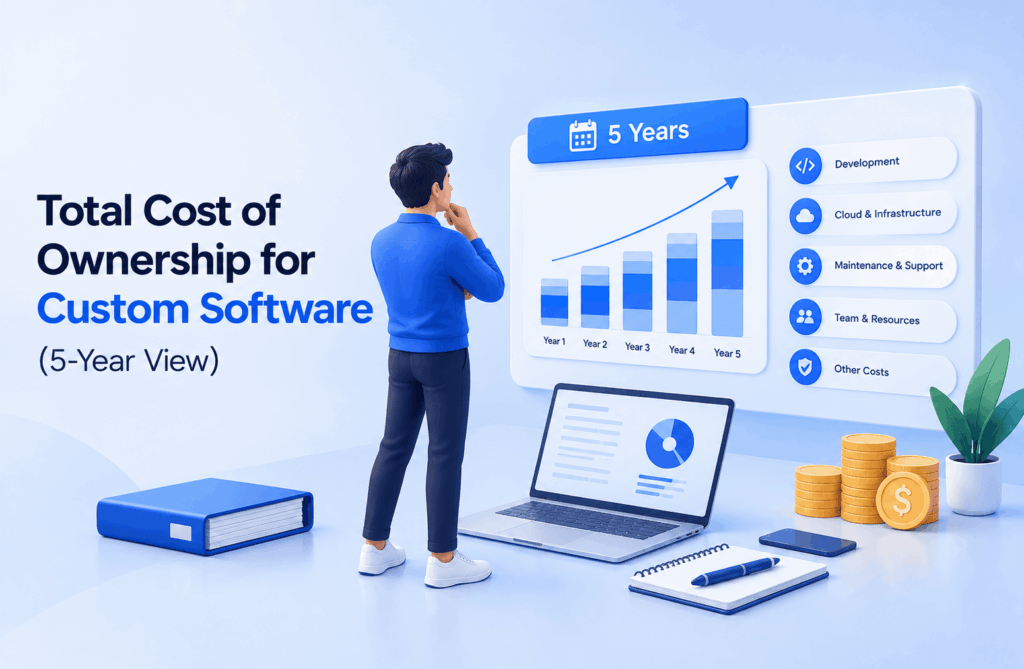
Total Cost of Ownership for Custom Software (5-Year View)
A $120,000 custom software build routinely turns into a 450,000–500,000 commitment by the end of year five. That gap is the difference between a build quote and the total cost of ownership custom software carries once hosting, maintenance, security, enhancements and internal management time are added up.
Procurement conversations still revolve around the first number. Agencies quote it, finance teams approve it and boards compare it against off-the-shelf tools. Yet across a five-year horizon, the initial build usually accounts for only 25–35% of total spend, whether the platform is a customer portal, an internal tool or a SaaS product.
The remaining 65–75% arrives in smaller invoices that never appear in a statement of work. A hosting bill rises with every new user, a support retainer renews each year, a penetration test lands every audit cycle and a product owner spends 10 hours a week managing the vendor. Each line looks minor in isolation, but combined they decide whether a platform pays for itself or becomes a budget problem by year three.
Most of these costs are locked in before development starts. Architecture choices, contract structure, documentation standards and the agency selected all set the trajectory of a realistic total cost of ownership custom software forecast long before launch day. Even the software development brief shapes it, because every scope gap becomes a change request later.
Gartner’s April 2026 forecast projects worldwide IT spending to reach $6.31 trillion in 2026, up 13.5% year over year. Software spending is expected to grow 15.1% to $1.44 trillion, while IT services, including application implementation and managed services, are forecast to exceed $1.87 trillion. As budgets grow, so does the price of getting long-term ownership wrong.
The sections below break the problem into parts. They cover how to model total cost of ownership of custom software over five years, which cost lines teams routinely miss, how vendor selection changes the long-term number and what experienced buyers do differently.
What Is the Total Cost of Ownership in Custom Software?
Total cost of ownership of custom software is the full amount a business spends to plan, build, host, maintain, secure and eventually replace a bespoke application over its useful life, usually modelled across five years. It combines one-time development costs with recurring infrastructure, support, licensing, compliance and internal management expenses.
Why Build Quotes Understate the Real Number
A build quote answers one question: what will it cost to reach version 1.0? It says nothing about the 1,500–1,800 days the software must run afterwards. That is how software development estimates work by design, and it is why most teams underestimate five-year spend by 3–4x when they budget from the quote alone. A quote that ignores those years is not a total cost of ownership custom software estimate; it is a down payment.
Four areas account for most of the hidden costs of custom software:
- Running costs. For a mid-sized B2B platform, cloud hosting costs commonly start at 500–1,500 per month and grow 10–20% a year as users and data volumes increase.
- Upkeep. Bug fixes, framework upgrades, browser and OS compatibility work and security patching continue for as long as the software is live.
- Change. Once real users arrive, feature requests follow through the software development change order process, and most platforms absorb new work worth 10–20% of the original build every year.
- People. Product ownership, vendor coordination and QA sign-off consume 0.25–0.5 of a full-time role, a cost rarely charged to the software budget.
Shortcuts compound as well. Code delivered without automated tests or documentation builds up technical debt that can push maintenance effort 30–50% above benchmark by year three, and a rushed MVP frequently needs a partial rebuild within 24–36 months. Each of those rebuilds lands directly on the total cost of ownership of a custom software line, usually without a budget code.
The result is a familiar pattern. Year one looks on budget and year two looks slightly over, yet by year three the total cost of ownership custom software budgets were meant to contain has become one of the larger recurring lines in the technology plan.
The 5-Year Total Cost of Ownership Custom Software Model
Five years is the standard horizon for good reason. It captures at least one major framework upgrade, one infrastructure decision and the full maintenance curve, while staying short enough to forecast with confidence. A credible total cost of ownership custom software model also needs to survive scrutiny from finance, not just engineering.
How to Calculate Total Cost of Ownership for Software
Regardless of project size, a reliable software TCO calculation follows the same eight steps:
- Fix the scope baseline. Document the version 1.0 feature set, integrations and user volumes in a project brief for developers, because the quote is based on it.
- Price the build in phases. Separate discovery, UX/UI design, development, QA and deployment so each can be benchmarked across vendors.
- Model infrastructure growth. Start from current hosting estimates and apply a 10–20% annual increase tied to projected users and data.
- Apply a maintenance rate. Budget 15–25% of build cost per year from year two, adjusted for code quality and test coverage.
- Add an enhancement allowance. Reserve 10–15% of build cost each year for new features and scope creep.
- List third-party and compliance costs. Include third-party API fees, licences, penetration tests and audits such as SOC 2 or ISO 27001 where required.
- Count internal time. Price the hours your team spends on product ownership, vendor coordination and acceptance testing.
- Add an exit reserve. Set aside 5–10% of build cost for a vendor transition or partial rework, even if it is never used.
The Cost Lines Behind a 5-Year Software Cost Forecast
Applying that method to a mid-complexity B2B web platform with a $120,000 build quote produces the following picture:
| Cost line | Year 1 | Years 2–5 | 5-year total |
| Initial build (discovery, design, development, QA) | $120,000 | – | $120,000 |
| Cloud hosting and infrastructure (+10% a year) | $9,600 | $49,000 | $58,600 |
| Maintenance and support (18% of build a year) | – | $86,400 | $86,400 |
| Feature enhancements (12% of build a year) | – | $57,600 | $57,600 |
| Licences and third-party services | $6,000 | $24,000 | $30,000 |
| Security and compliance (pen tests, audits) | $8,000 | $32,000 | $40,000 |
| Internal product and vendor management | $15,000 | $60,000 | $75,000 |
| Total | $158,600 | $309,000 | $467,600 |
In this model, the build is only 26% of five-year spend. Every $1 approved at the quote stage commits roughly $2.90 in follow-on costs, which is why the total cost of ownership of a custom software figure, not the quote, should drive approval.
How Much Does Custom Software Cost to Maintain Per Year?
The answer depends heavily on how the software was built. For a well-documented application with 70% or more automated test coverage, custom software maintenance costs typically sit near 15% of build value a year. Poorly documented systems with thin test coverage often run at 25–35%, because every change takes longer and carries more regression risk. Benchmarks for software maintenance cost per year follow the same pattern across most technology stacks.
Contract terms matter as much as the rate. A clear service level agreement that defines response times, uptime targets and included hours prevents the open-ended billing that inflates year-two and year-three spend. Without one, total cost of ownership custom software estimates drift upward every quarter.
Is Custom Software Cheaper Than SaaS Over 5 Years?
Sometimes, list prices rarely reveal the answer. A fair build vs buy software cost comparison sets five years of subscriptions, per-seat growth, integration work and workaround effort against the full model above, not against the build quote.
Take a SaaS tool at $60 per user per month for 150 users. That costs $540,000 over five years before any price increases, so a $467,600 custom platform can be the cheaper option once code ownership and control over core workflows are factored in. At 20 users, the same subscription costs $72,000 and the maths favours SaaS almost every time. Running both options through a full total cost of ownership custom software comparison is what makes the decision defensible.
How Vendor Selection Shapes Years 3 to 5
The agency you choose sets more of the five-year number than any single technical decision. Each of the following choices compounds across the total cost of ownership of a custom software budget. A practical way to compare software development companies is to score each one against the cost lines in the table above, not against day rates.
The first is the contract model. A fixed-price contract caps build risk but can encourage shortcuts that surface later as maintenance cost, while a time-and-materials contract offers flexibility but needs tight scope governance. Many experienced buyers use fixed price for discovery and version 1.0, then move to a capped time-and-materials retainer.
The second is delivery discipline. Ask shortlisted agencies for evidence of automated testing, CI/CD pipelines, code review standards and documentation handover, and add references from similar builds to your questions to ask a software development company. Agencies that cannot show these practices usually push total cost of ownership custom software higher from year two onwards.
The third is ownership and exit terms. Contracts should assign full IP, source code and infrastructure credentials to the client. Without them, vendor lock-in can turn a routine transition into a 3–6 month, 40,000–80,000 rebuild. That single clause can add 10–15% to the total cost of ownership of custom software in the year it is triggered.
Real-World Application: Two Five-Year Outcomes
The two anonymised scenarios below show how the same type of project can produce very different five-year results. Both were mid-sized builds, yet their total cost of ownership of custom software outcomes diverged sharply.
Lowest bid, highest bill. A Series A logistics startup sourced a shipment-tracking platform through a commission-based bidding site, choosing a $68,000 bid over quotes of 95,000–110,000. The delivered code had under 15% test coverage, maintenance ran at roughly 32% of build value, and refactoring the core modules cost $54,000 in month 26. Its total cost of ownership of custom software projection rose from $210,000 to more than $400,000.
Verified partner, predictable spend. A mid-market manufacturer spent three weeks running a vendor due diligence checklist across four verified agencies for a dealer portal and chose a $112,000 proposal that included automated tests, CI/CD and a documented handover. A capped SLA retainer kept maintenance near 16% of build value a year. Three years in, actual spend sits within 8% of the original total cost of ownership custom software forecast.
Decision Framework: How Sourcing Models Affect 5-Year TCO
Where and how you hire the build team affects long-term cost through three channels: vendor quality, intermediary fees and switching costs. For software development budget planning, run every shortlisted option through the same five-year model instead of comparing build quotes side by side. Doing so exposes total cost of ownership custom software differences that a quote comparison hides.
| Sourcing model | Upfront cost signal | Hidden 5-year cost | TCO risk |
| In-house team | Salaries, hiring fees, 3–6 month ramp-up | Attrition, knowledge loss, benefits overhead | Medium to high for non-core builds |
| Freelancers | Lowest hourly rates | Single point of failure, limited QA, documentation gaps | High |
| Commission-based bidding marketplace | Competitive bids | 10–20% platform fees, race-to-the-bottom pricing, unverified vendors | High |
| Paid-listing directory | Large agency pool | Sponsored rankings over fit; vetting falls on the buyer | Medium |
| Direct-connect verified marketplace | No commission, pre-verified agencies | Buyer still owns scope and contract governance | Low to medium |
Commission fees deserve particular attention. When a platform takes 10–20%, the cost is usually built into the agency’s rate, so the buyer pays it on the build and again on every maintenance invoice for five years. On the $467,600 model above, a 15% embedded margin equals roughly $70,000 of spend that buys no engineering at all. It is the core difference in the agency marketplaces vs direct matching debate.
Commission-free models such as GetProjects remove that layer by connecting businesses directly with verified agencies. The quoted rate then reflects engineering time rather than platform fees, which keeps total cost of ownership custom software comparisons honest across vendors.
What Most Teams Get Wrong
The most expensive line in most five-year models is not hosting or maintenance. It is the decision made in the first three weeks of vendor selection, when teams compare hourly rates instead of cost per outcome.
A $35-per-hour team that needs 2,400 hours costs $84,000. A $55-per-hour team that needs 1,400 hours costs $77,000, and it usually leaves behind cleaner code that is cheaper to run for the next four years. Rate cards measure inputs, and total cost of ownership of custom software is determined by outputs. Comparing software developer hourly rates by country without the hours attached misleads in exactly the same way.
Another mistake is treating maintenance as a percentage rather than a scope. “20% a year” means nothing without a defined list of included work, response times and hour caps. Teams that skip this step end up paying for maintenance and then again for the enhancements hidden inside it. It is one of the most common reasons total cost of ownership custom software forecasts miss by 20% or more.
Internal time is the line most often left off the books. A product lead spending 10 hours a week chasing a poorly chosen vendor carries an opportunity cost that never appears on an invoice, yet it often exceeds the hosting bill.
Finally, few teams price their exit. Every vendor relationship ends eventually, and the cost of that transition is set on day one by documentation standards, IP clauses and access to infrastructure. Budgeting for it early is the cheapest insurance in any total cost of ownership custom software plan.
Model the Five-Year Number Before You Sign
The quote is the smallest number you will see in a custom software project, and the easiest to control. A realistic total cost of ownership custom software model turns that quote into a decision finance can stand behind.
If you are scoping a custom build and want to compare verified agencies without paying commissions or bidding blind, GetProjects lets you post a project free in under two minutes and get matched with vetted tech partners based on budget, expertise and delivery history. You pay only the agency you hire, so every line of your five-year model goes towards engineering work. Post your project on GetProjects.
Frequently Asked Questions
What is included in software TCO?
A complete estimate covers the initial build, cloud hosting and infrastructure, annual maintenance and support, feature enhancements, third-party licences and APIs, security and compliance work, internal management time and an exit reserve. Most teams capture the first three and miss the rest. Across a five-year view, the omitted lines can add 40–60% to the total cost of ownership of custom software figure finance originally approved.
How long does custom software last before it needs a rebuild?
Well-architected custom software with continuous maintenance commonly stays in service for 7–10 years, with incremental modernisation along the way. Systems built quickly with weak architecture, little test coverage or outdated frameworks often need a partial or full rebuild within 3–5 years. The quality of the original build and the maintenance discipline that follows matter far more than the technology stack chosen.
Which costs do businesses most often leave out of a TCO estimate?
The most frequently missed items are internal product management time, compliance audits, data migration, hosting growth beyond year one and vendor transition costs. Each can look small on its own. Together, they regularly add 50,000–150,000 to a five-year model for a mid-complexity platform, which is why a structured checklist matters more than a quick spreadsheet.
Is building custom software worth it compared to an off-the-shelf tool?
It depends on user count, how unique your workflows are and how long you plan to run the system. Custom builds tend to win when seat counts are high, workflows create competitive advantage or integration needs are complex. Off-the-shelf tools usually win for small teams and standard processes. Comparing five-year costs for both options gives a clearer answer than comparing a build quote with a monthly subscription.
How can a business reduce total cost of ownership custom software spending without cutting quality?
Start with vendor selection, because code quality sets maintenance cost for years. Insist on automated tests, CI/CD and documentation in the contract, define maintenance by scope rather than percentage, and secure full IP and infrastructure access. Avoiding commission-based platforms also removes a 10–20% margin that otherwise repeats on every invoice for the life of the system.
How should I compare agency quotes with a five-year view?
Ask each shortlisted agency to price maintenance, SLA terms, hosting assumptions and enhancement rates alongside the build, then run every quote through the same five-year model. Posting a scoped project brief on a commission-free marketplace makes this easier, because verified agencies respond to identical inputs. From there, a short scoping call with the top two or three usually reveals which proposal holds up.