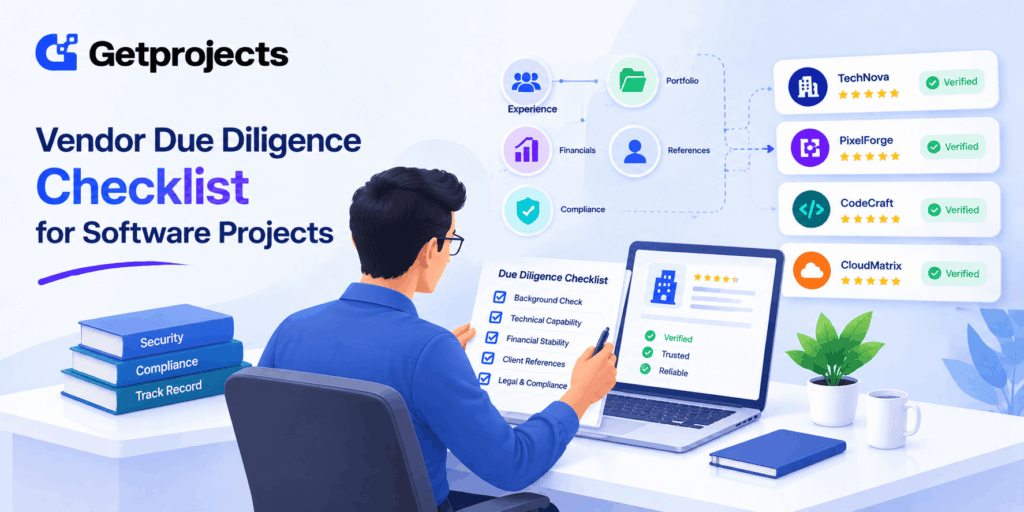
Vendor Due Diligence Checklist for Software Projects
Most software vendor failures are visible before the contract is signed. The delivery lead who resigns in week six, the overdue tax filing, the offshore subcontractor nobody mentioned, the contract with no IP clause: nearly all of it sits in documents a buyer could have requested. A vendor due diligence checklist software buyers apply to every shortlisted partner brings that evidence to the surface before it becomes a delay.
Buyers rarely skip checks entirely. What happens instead is that legal reviews the contract, finance glances at a balance sheet, engineering runs one technical interview, and security sends a 200-question spreadsheet that comes back half-complete three weeks later. Each function signs off on its own slice, and nobody compares three vendors on one scale.
Verizon’s Data Breach Investigations Report found that the share of breaches involving a third party doubled from 15% to 30% in a single year, based on an analysis of 12,195 confirmed data breaches.
That figure changes how vendor selection should work. Once an agency holds repository access, staging credentials and sample customer data, its security posture effectively becomes yours, and a polished portfolio tells you nothing about it. Financial fragility works the same way: an agency that runs out of cash in month four takes your roadmap down with it.
This guide puts legal, financial, technical, security and delivery checks into one scored framework. The framework is a vendor due diligence checklist software teams can grade from 0 to 5 per criterion. Its table places three vendors side by side, applies weights that match your project’s risk, and produces a decision you can defend to a CFO, a board or an auditor.
What Is Vendor Due Diligence for Software Projects?
Vendor due diligence for software projects is the structured verification of a development partner’s legal standing, financial health, technical capability, security controls and delivery record before a contract is signed. It turns sales claims into documented evidence, scored on identical criteria for every shortlisted vendor, so the final choice rests on proof rather than presentation.
The process depends on its working document. A reusable vendor due diligence checklist software buyers maintain assigns an evidence requirement, a score and a weight to each criterion. It also flags knockout items that disqualify a vendor regardless of total score.
Due diligence covers more ground than a vendor risk assessment checklist, which usually covers security and compliance exposure alone. Due diligence also asks whether the vendor can build what you need, on schedule, with the team it presented. For that reason, a vendor due diligence checklist software procurement leads should have one owner rather than four departments.
Why Software Vendor Selection Fails Before Kickoff
Most selection processes weigh the wrong evidence. Portfolios, case study decks and the pitch call typically drive 70–80% of the decision. The factors that actually predict failure, such as team stability, financial runway, subcontracting and contract terms, get checked late or skipped. A rigorous software supplier assessment reverses that ratio.
The cost of skipping it is measurable. Replacing a vendor mid-build usually adds 3–5 months to the timeline. The incoming team often reworks 30–50% of the inherited codebase because it arrives without tests, documentation or a clear architecture. That technical debt rarely shows up in a demo.
Three failure patterns account for most problems in agency engagements:
- Bait-and-switch staffing. Senior engineers join the pitch, and mid-level developers are assigned after signature. Without a named-resource clause, there is no remedy.
- Underpricing to win. Bidding marketplaces that take 10–20% commission push agencies to underbid. The agencies then recover margin through change requests worth 20–40% of the original quote.
- Hidden subcontracting. The agency you vetted hands half the work to a partner you never assessed. That breaks your security review and your IP chain at once.
Enterprise third-party risk management programs exist, but they are built for SaaS tools and suppliers, not for custom development partners writing code you will own. That gap is why procurement and engineering leads need a single vendor due diligence checklist software they share: one instrument, one scale, one accountable owner. Without it, a vendor due diligence checklist software process splits back into four separate opinions.
How to Run Due Diligence Before Signing Vendor Contracts
Every check below maps to a row in the scored table. A $50,000–$250,000 project needs 2–3 weeks of structured review, and enterprise programs need 4–6 weeks. The order of steps matters as much as their content, because a vendor due diligence checklist software teams run out of order produces scores nobody trusts.
How to Evaluate a Software Development Vendor in 7 Steps
- Define knockout criteria: agree internally on non-negotiables, such as full IP transfer, named senior staff or a specific compliance standard, before speaking to any vendor.
- Set category weights: allocate 100 points across legal, financial, technical, security and delivery based on project risk.
- Issue one evidence request: send the same document list to all three vendors with a 5–7 business day deadline.
- Score independently: legal, finance, engineering and security each score their rows without seeing other reviewers’ scores.
- Run a paid technical trial: a 1–2 week scoped task costing $2,000–$5,000 reveals code quality and communication faster than any interview.
- Call references you choose: ask for five past clients and contact two the vendor did not pre-select.
- Calculate and negotiate: total the weighted scores, discuss any reviewer gap above 1.5 points, and write the winner’s weakest areas into the contract.
Legal Checks: Contracts, IP and Liability
Buyers most often accept vendor templates without negotiation at the legal stage. The master service agreement should cap liability at no less than 12 months of fees, include a named-resource clause, and allow termination for convenience with 30 days’ notice. Each statement of work needs acceptance criteria written as testable outcomes, not phrases like “fully working application.”
The most expensive omission is ownership that transfers only “upon final payment.” A proper intellectual property assignment transfers code, designs and documentation as each milestone is paid, so a dispute in month five does not strand the code you already funded. Any vendor due diligence checklist software founders adopt should treat refusal on this point as a knockout.
Financial Checks: Runway, Concentration and Payment Terms
A small agency can deliver excellent work and still collapse mid-project. Run a financial stability check vendor by vendor. Request two years of filed or audited accounts, headcount trends over 12 months, and the revenue share of the top three clients. If a single client exceeds 40% of revenue, losing that account could destabilize the team assigned to you.
Payment structure is a risk control in its own right. Milestone payments with 10–15% held until acceptance protect you better than retainers paid in advance. For products your business depends on, source code escrow preserves access to the latest build if the vendor becomes insolvent. A vendor due diligence checklist software buyers trust also includes registry searches for liens, litigation and director disqualifications, which take under an hour.
Technical Checks: Architecture, Code Quality and the Actual Team
Verify technical capability against your stack and scale, not the vendor’s showcase projects. Request a redacted code sample from a comparable build, an architecture document of similar complexity, and the vendor’s default testing and CI/CD practices. Test coverage below 60% is a warning sign for anything with a multi-year lifespan.
Interview the people who will build, not the pre-sales architect. Confirm that the proposed tech lead and senior developers have 18+ months of tenure, check their GitHub activity, and write their names into the contract. This row changes vendor rankings more often than any other in a vendor due diligence checklist software evaluation, because the strongest pitch team and the strongest delivery team are frequently different people.
Security and Compliance Checks
Security scoring should scale with data sensitivity. For vendors touching production systems or personal data, request a current SOC 2 Type II report or ISO 27001 certificate, a summary of the latest penetration testing engagement, and documented offboarding procedures. Vendors without certification can still qualify for early-stage builds if they demonstrate MFA on all repositories, encrypted secrets management and a 24–72 hour breach notification commitment.
Also confirm where data will reside and which subprocessors are involved. A vendor due diligence checklist software projects in fintech or healthtech usually makes GDPR, HIPAA or RBI alignment a knockout rather than a scoring criterion.
Delivery Checks: Track Record, References and Governance
Delivery evidence is the hardest to fake and the most often skipped. Run reference checks with two clients whose projects ended in the last 18 months. Ask what went wrong, how the vendor responded, and whether they would rehire the same team.
Governance matters as much as history. Confirm the escalation path, reporting cadence, a time-zone overlap of at least 3–4 hours, and how scope changes are priced. Once a vendor clears your threshold, these findings feed the supplier onboarding checklist IT teams use to provision access and assign security owners in the first two weeks. Linking the two documents means a vendor due diligence checklist software buyers complete keeps being used after signature instead of being filed away.
Case Studies: What Scored Due Diligence Changes in Practice
A Series A fintech in Bengaluru shortlisted three agencies for a $140,000 lending app. The agency ranked first on portfolio scored lowest on delivery once reference calls revealed that roughly 60% of its work went to an unvetted subcontractor. The team completed its vendor due diligence checklist software review in 16 working days, switched to the second-ranked vendor, and launched its MVP in 19 weeks against a 20-week plan.
A US healthtech company found that two of its three offshore finalists had no data processing agreement template and no HIPAA experience. Treating security as a knockout category cut the evaluation from a planned 9 weeks to 4. The vendor that cleared the vendor due diligence checklist software threshold passed the client’s internal compliance audit on its first attempt.
The Consolidated Vendor Due Diligence Checklist Software Buyers Can Score
The table below combines all five categories into 20 criteria. Score each criterion from 0 (no evidence or failed) to 5 (strong, documented evidence). Rows marked (K) are knockouts: a score of 0 or 1 disqualifies the vendor regardless of total. The weights suit a typical $50,000–$250,000 custom build. Shift 5–10 points toward security for regulated data, or toward technical for complex architecture.
How to Compare Software Vendors Side by Side
For each category, use this formula: (sum of the four criterion scores ÷ 20) × category weight. Add the five results for a total out of 100. For example, a vendor scoring 16 of 20 on technical earns 20 of the 25 technical points.
Apply three decision bands. Vendors at 80 or above proceed to contract. Vendors at 65–79 proceed only after their weakest category is negotiated into specific clauses. Below 65, walk away regardless of price. The bands turn the sheet into a working vendor scorecard that finance and engineering read the same way, and they keep the vendor due diligence checklist software results auditable months later.
Buyers sourcing through a verified marketplace such as GetProjects can pre-fill parts of the legal and delivery rows using existing checks on website, email domain, reviews and team details. Those rows still need documents behind them. Even so, any vendor due diligence checklist software framework moves faster when the vendors entering it have already had their identity confirmed.
What Most Teams Get Wrong About Vendor Due Diligence
The most common mistake is treating due diligence as a final gate instead of an early filter. Teams sit through three rounds of demos, fall for one vendor, and then run checks that only confirm a decision already made. Applying knockout criteria before the first demo typically removes one of three vendors immediately and saves 2–3 weeks.
Teams also have overweight credentials and underweight people. A SOC 2 report proves a company has controls, but it says nothing about whether the four developers assigned to you have shipped a similar product. For builds under $200,000, a vendor due diligence checklist software CTOs trust weights the named-team row above the certificate row.
Reference calls get treated as formalities. Vendors offer their three happiest clients, which shows their best outcomes, not their typical delivery track record. The call that changes decisions is with a client the vendor did not suggest, and the same skepticism applies when you verify agency reviews posted online.
Finally, the score is not the end of the process. It is a negotiation map. If your top vendor scores 2 out of 5 on payment terms, that row becomes a contract clause. Teams that average reviewer scores instead of discussing gaps lose the most useful signal a vendor due diligence checklist software exercise produces.
Build Your Shortlist Before You Build Your Scorecard
Due diligence is only as strong as the vendors entering it. If you want to start from agencies that have already passed website, domain, review and team verification, GetProjects lets you post a project free in under two minutes and connect directly with vetted IT partners. There are no bidding wars and no commission. Shortlist three, run them through this vendor due diligence checklist software framework, and sign based on evidence instead of instinct.
Frequently Asked Questions
What should a vendor due diligence checklist include?
It should cover five categories: legal terms and IP ownership, financial stability, technical capability, security controls, and delivery record. For each criterion, a practical vendor due diligence checklist software buyers can reuse lists of the required evidence, a 0–5 score, a category weight and any knockout rule. That lets three vendors be compared on one sheet instead of across separate email threads.
How long does vendor due diligence take?
For projects between $50,000 and $250,000, expect 2–3 weeks. That includes a 5–7 day document window and a 1–2 week paid trial. Enterprise programs with regulated data typically need 4–6 weeks because security reviews and legal redlines take longer. Running knockout criteria first removes weak vendors early and keeps the timeline predictable.
How do you check a software vendor’s financial stability?
Request two years of filed or audited accounts, 12-month headcount trends, and the revenue share of the vendor’s top three clients. Then search public company registries for liens and litigation. Heavy client concentration, shrinking headcount or refusal to share any financial data should lower the score significantly. For critical products, negotiate an escrow arrangement as a fallback.
What is the difference between vendor due diligence and vendor risk assessment?
Vendor risk assessment focuses on exposure: the security, privacy and compliance risk a third party introduces. Due diligence is broader and happens before selection. It also tests whether the vendor can deliver the project at the promised quality, cost and timeline. In software projects, risk assessment usually becomes one weighted category within the vendor due diligence checklist software teams run.
What documents should you request from a software vendor?
At minimum, request:
- a draft MSA and SOW
- IP assignment language and employee IP agreements
- two years of financial statements
- a code sample and CVs of the named team
- a SOC 2 or ISO 27001 report where relevant
- a recent pen test summary
- a subprocessor list and five client references
Send the identical list to every vendor so the vendor due diligence checklist software scores stay comparable.
What are the red flags when hiring a software development agency?
Watch for:
- refusal to name the delivery team in the contract
- IP that transfers only on final payment
- references limited to hand-picked clients
- a quote 25% or more below comparable vendors
- vague answers about subcontractors
One red flag warrants a knockout discussion. Two or more usually mean the engagement will cost more than quoted.
Who should be involved in vendor due diligence?
Assign one owner, usually a CTO, engineering manager or procurement lead, plus scorers for legal, finance, engineering and security. Smaller companies can combine roles, but scoring should stay independent. If your team lacks the bandwidth to build a shortlist worth scoring, starting from agencies that have already passed marketplace verification saves the first week and focuses review time on the vendors that matter.