
Best Software Development Companies in India in 2026 How to Find the Right One for Your Budget
India produces more software engineers than any country on earth, 1.5 million engineering graduates per year, the world’s second-largest developer community, and 30 years of building production software for US, UK, and European companies. The country’s software services exports crossed $245 billion in FY2026. Every major technology company Google, Microsoft, Amazon, IBM has significant engineering centres in India.
And yet the experience of hiring an Indian software development company for a $10,000 project is wildly inconsistent. Some buyers get excellent engineers, well-managed delivery, and production-quality code. Others get missed deadlines, communication gaps, and code that works in development but breaks in production. The difference is not India vs not-India. The difference is which agency, how well it is managed, and how clearly the project was scoped.
This guide covers how to evaluate and shortlist Indian software development companies in India specifically for $5K to $30K projects, the budget range where India offers the most compelling value.
Why India for Software Development The Real Advantages
The obvious advantage is cost. An experienced full-stack developer in Pune or Bangalore earns $15,000 to $35,000 annually. The equivalent developer in London earns $80,000 to $120,000. That cost difference is real, structural, and not going away.
But cost is not the only reason. The talent quality argument is often dismissed and should not be. IIT graduates who turned down $250K Google offers to build their own agency.
Developers who spent 5 years at Infosys building enterprise systems for Fortune 500 clients before starting a boutique shop.
Teams that have shipped production ML systems, real-time fintech platforms, and consumer apps with millions of users. This talent exists in India at scale.
The practical advantages for $5K–$30K buyers:
| Advantage | What It Means in Practice |
| Cost efficiency | 3–5× more development hours per dollar vs UK/US |
| English proficiency | India ranks among the top countries globally for English-speaking developer talent |
| Time zone coverage | India is 5.5 hours ahead of UK, 10.5 hours ahead of US East Coast early morning overlap with US, good overlap with UK/Europe |
| Startup experience | Many Indian agencies have specifically built for US/UK startups for years and understand the product development mindset |
| Tech stack depth | Strong in React, Node.js, Python, Flutter, React Native the standard modern web and mobile stack |
The Indian Agency Landscape What Types Exist at $5K–$30K
India has two kinds of software development companies that operate at the $5K–$30K budget level and one type that claims to but does not.
Type 1 Product-focused boutique agencies (10–40 people):
These are agencies built by developers-turned-founders who care about what gets built, not just that something gets delivered. They have a defined technology specialisation, a visible portfolio of live products, and direct access to senior engineers throughout the project. This is the type that consistently delivers the best outcomes at the $5K–$30K range. They are typically based in Bangalore, Pune, Hyderabad, or Indore.
Type 2 Generalist small agencies (5–20 people):
These agencies can do most standard web and mobile development work adequately. They lack the specialisation of boutique agencies but compensate with flexibility and competitive pricing. Quality varies: the best ones have built real products for real clients. The weakest ones are essentially freelancers with a company registration.
Type 3 Large enterprise agencies presenting as SME-friendly:
Large Indian IT companies, even mid-size ones with 200+ employees, sometimes pitch for $10,000 projects when business is slow. The economics do not work in the buyer’s favour. A 300-person agency has overhead that makes a $10,000 project unprofitable at the rates they need to charge to survive. These projects get assigned to the most junior available team, get the least management attention, and consistently underperform. Avoid this type for sub-$30K projects regardless of how impressive the pitch is.
What to look for in each type:
| Criterion | What to Check |
| Live product portfolio | Can you download or access a product they built? Not a screenshot a working product |
| Client geography | Have they worked with clients from your country before? Communication style differs significantly |
| Team stability | How long have the key people been with the agency? High churn = quality risk |
| Founder involvement | Is the founder/senior engineer involved in delivery or just sales? |
| Communication samples | Ask for a sample project update report from a previous project |
How to Evaluate Indian Development Companies The Interview Process
The evaluation process for an Indian agency is no different from evaluating any agency but the specific signals to look for differ slightly because of the geographic and cultural context.
The reference call is non-negotiable:
With Indian agencies, you must speak to at least one previous client who is based in your country and has completed a project of similar size. Not a written testimonial or an actual 15-minute phone call. Ask: How was communication managed across time zones? Were deadlines met? What happened when something went wrong? Would you use them again?
Agencies that cannot provide a reference from a client in your country who completed a project in the last 18 months are not yet proven for remote cross-border delivery at your budget level.
The technical interview:
For projects above $10,000, it is worth having a 30-minute technical conversation with the senior developer who will actually work on your project, not the account manager who handles the sales process. Ask them to describe the technical architecture of a recent project. A developer who can articulate architecture decisions clearly, explain trade-offs, and proactively identify risks in your project description is the developer you want.
Communication trial:
Before signing any contract, do a paid 2 to 3 day discovery sprint typically $300 to $600. Ask the agency to review your requirements, ask clarifying questions, and produce a brief technical specification. This single investment reveals three things: their communication quality under real working conditions, their technical depth, and whether their process is structured enough to deliver a consistent outcome.
Time Zone Management Making India–US or India–UK Collaboration Work
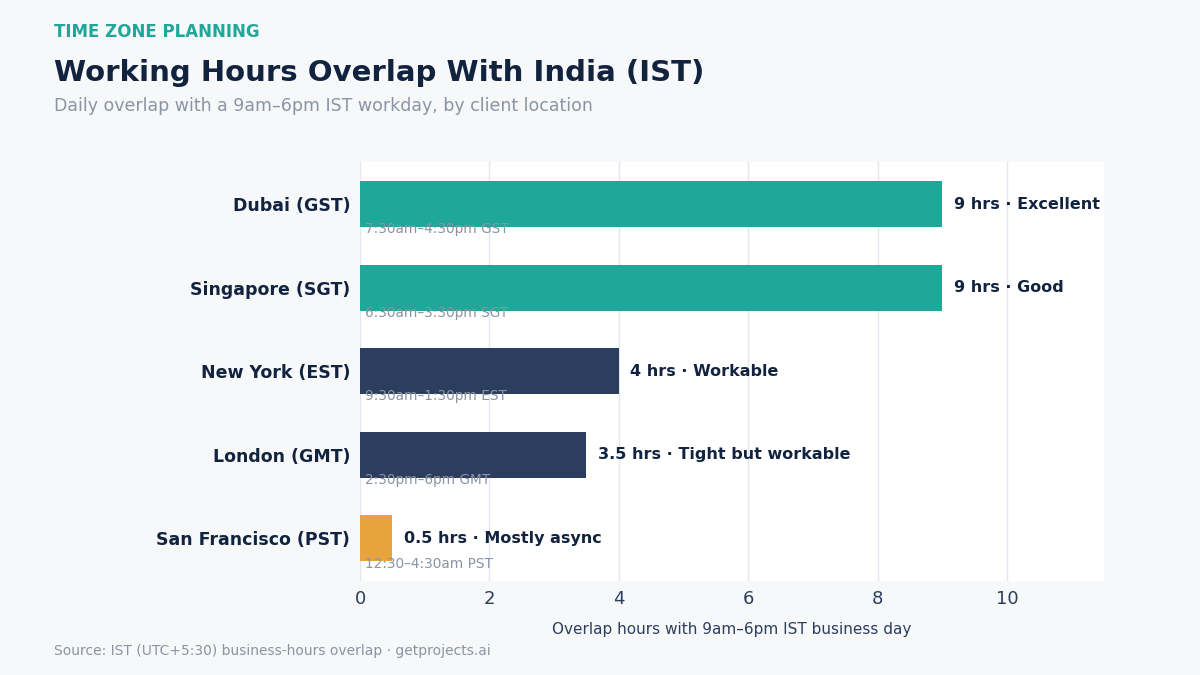
The most common concern about Indian development companies is time zone overlap. India Standard Time (IST) is UTC+5:30. This means:
| Your Location | Overlap with IST Business Hours (9am–6pm IST) |
| New York (EST) | 9:30am–1:30pm EST overlap (4 hours) workable |
| London (GMT) | 2:30pm–6pm GMT overlap (3.5 hours) tight but workable |
| San Francisco (PST) | 12:30am–4:30am PST overlap typically async with morning check-ins |
| Dubai (GST) | 7:30am–4:30pm GST overlap (excellent) |
| Singapore (SGT) | 6:30am–3:30pm SGT overlap (good) |
For US West Coast buyers, the time zone difference is the most challenging. The practical solution that works: require the agency to have a senior team member available for a 30-minute video call between 8am and 9am IST (which is 7:30pm to 8:30pm PST the previous day).
Pair this with async communication through Slack detailed written updates every day by end of IST business hours, reviewed during your morning. This workflow works well for most project types and is the standard operating model for hundreds of successful India-US software partnerships.
Cost Benchmarks for Indian Development Companies
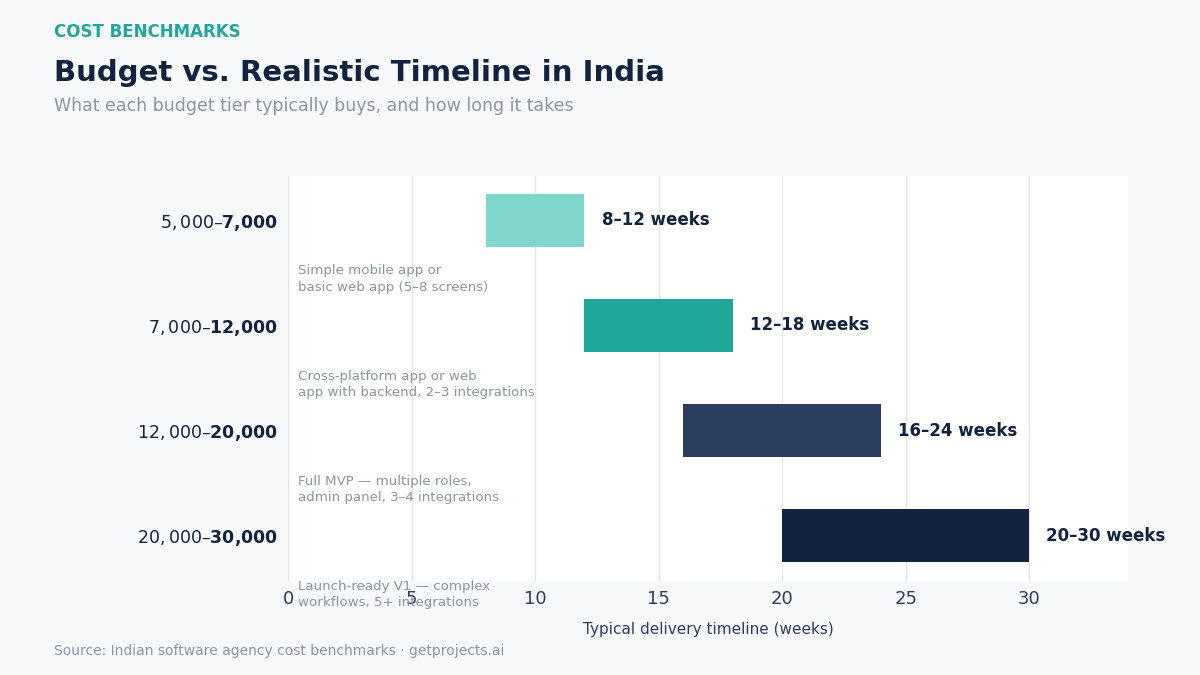
What your budget realistically builds with a strong Indian agency:
| Budget | Realistic Deliverable | Typical Timeline |
| $5,000–$7,000 | Simple mobile app (one platform) or basic web application 5–8 screens, standard features, one integration | 8–12 weeks |
| $7,000–$12,000 | Cross-platform mobile app (iOS + Android) or web application with backend user auth, 10–15 screens, 2–3 integrations | 12–18 weeks |
| $12,000–$20,000 | Full MVP multiple user roles, core feature set, admin panel, 3–4 integrations, basic analytics | 16–24 weeks |
| $20,000–$30,000 | Launch-ready V1 product multiple user types, complex workflows, 5+ integrations, performance optimisation | 20–30 weeks |
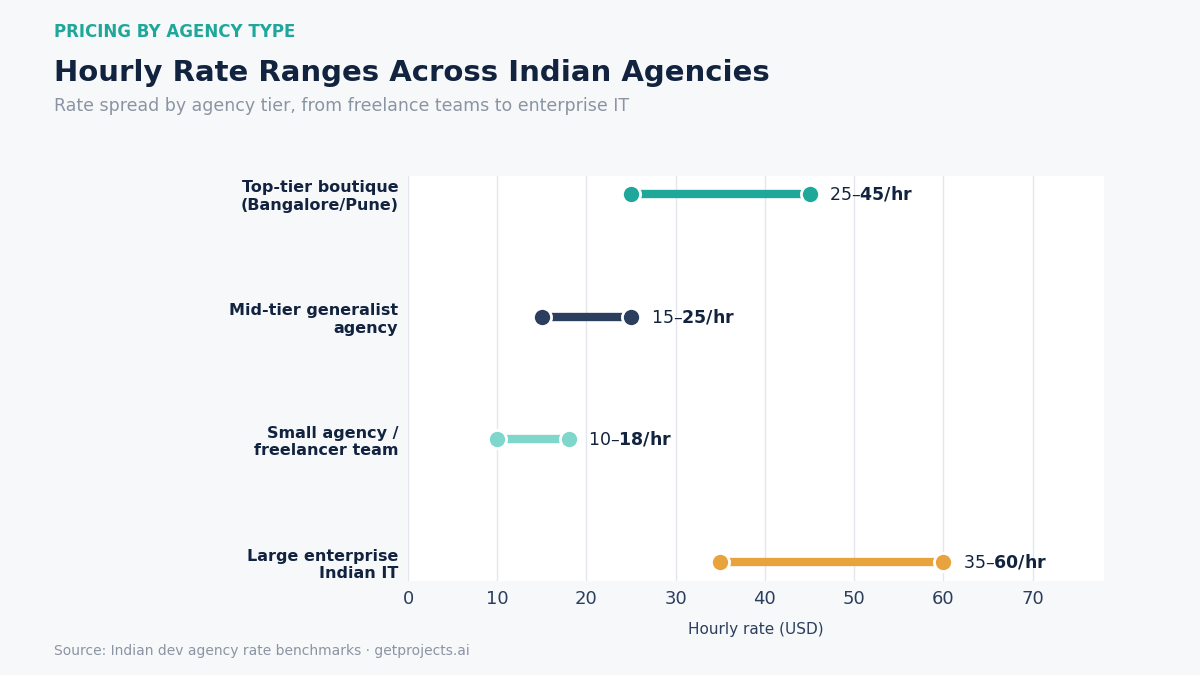
Rate ranges for Indian agencies by type:
| Agency Type | Hourly Rate Range | Best For |
| Top-tier boutique (Bangalore/Pune) | $25–$45/hour | Complex products, startup CTOs who know what good looks like |
| Mid-tier generalist agency | $15–$25/hour | Standard web and mobile, well-defined scope |
| Small agency / freelancer team | $10–$18/hour | Simple projects, price-sensitive buyers with clear specs |
| Large enterprise Indian IT (Infosys, Wipro tier) | $35–$60/hour | Enterprises needing process compliance not right for $5K–$30K |
Red Flags Specific to Indian Agencies
Beyond the universal red flags, Indian agencies have some specific patterns worth knowing.
A portfolio that lists client names without verifiable products is a common pattern. A large Indian agency might list 200 client logos without a single live product URL. Client logos prove nothing without evidence of what was actually built.
An agency that significantly undercuts every competitor’s quote is not finding efficiencies you have not found they are underscoping. An Indian agency quoting $4,000 for a project where every other Indian agency quotes $12,000 either does not understand the scope or has decided to lock you in with a low initial number and add change requests.
An agency that assigns a non-technical account manager as your sole point of contact and routes all technical questions through them is creating a communication bottleneck that slows every decision and distorts every requirement. You need direct access to the lead developer on your project.
Frequently Asked Questions
Is it safe to outsource software development to India?
Yes with appropriate due diligence. India has been the world’s primary software outsourcing destination for 30 years. Millions of successful projects have been delivered by Indian agencies for US, UK, European, and Australian clients. The risks are not geographic; they are contractual and managerial. Signing a contract that includes clear milestone definitions, IP ownership clauses (ensure all IP transfers to you on payment), code repository access throughout the project, and source code escrow for mission-critical projects reduces the risk to an acceptable level. The additional due diligence steps verifying references, doing a paid discovery sprint, and maintaining access to your own cloud infrastructure are standard practice for any outsourced software project regardless of country.
How do I handle intellectual property when working with an Indian development company?
Your contract must include an explicit IP assignment clause: all code, designs, and deliverables created during the project are owned by you upon payment. This is standard in most professional Indian agency contracts but verify it explicitly rather than assuming. Additionally: maintain your own GitHub repository and require the agency to commit to it throughout the project (not just hand you a ZIP file at the end), own your own cloud infrastructure accounts (AWS, GCP agency has access but you own the accounts), and use your own domain registrar. These three controls ensure that if the relationship ends for any reason, you have everything you need to continue development with a different team.
What is the best city in India to find software development companies?
Bangalore is India’s technology capital home to the highest concentration of strong engineering talent and agencies with genuine product development experience. Pune is a close second strong university ecosystem, slightly lower cost than Bangalore, with many agencies with solid US/UK client track records. Hyderabad has a strong enterprise IT heritage and is producing increasingly good product-focused agencies. Indore, Jaipur, and Ahmedabad have growing tech ecosystems with agencies that offer competitive rates and often more personalised attention than metro-city agencies. For most buyers, the city matters less than the specific agency’s track record. A strong agency in Indore will outperform a weak agency in Bangalore every time.