Custom Software Development Cost in 2026 The Complete Budget Guide
The most common answer to “how much does custom software development cost?” is “it depends.” That answer is technically accurate and practically useless. Every founder, product manager, and business owner asking this question has a real budget and needs to know whether that budget is enough to build what they have in mind.
The global custom software market processed $650 billion in projects in 2025. The median project budget for a startup or SME building their first custom software product is $8,000 to $25,000. The range is enormous from $3,000 for a simple mobile app prototype to $500,000 for an enterprise platform but within each complexity tier, costs are far more predictable than the “it depends” answer suggests.
According to Statista, global software market revenue is projected to exceed $858 billion in 2026, reflecting the growing demand for custom-built solutions across industries. Yet within this massive market, actual project costs follow more predictable patterns than most agencies suggest.
This guide breaks down exactly what custom software development costs in 2026 by geography, by project type, by complexity, and by what is and is not included in a typical agency quote.
What Factors Determine Custom Software Development Cost?
Cost is the product of time multiplied by rate. Every factor that affects either variable affects the final price.
The seven factors that drive cost:
| Factor | Low-Cost Scenario | High-Cost Scenario |
| Development team location | India or Southeast Asia at $15–$35/hour | US or Western Europe at $100–$180/hour |
| Project complexity | Simple app, 5–8 screens, standard features | Complex platform, multiple user types, custom algorithms |
| Requirements clarity | Detailed spec with wireframes and user stories | Vague idea requiring discovery and design research |
| Technology choices | Common stack (React + Node.js + PostgreSQL) | Niche technology, proprietary integrations, legacy systems |
| Design requirements | Standard component library (Material UI, Tailwind) | Custom design system, complex animations, unique UX |
| Integration count | One or two standard APIs (Stripe, Twilio) | Multiple enterprise integrations (SAP, Salesforce, custom APIs) |
| Quality requirements | Standard QA manual testing | Automated test coverage, penetration testing, compliance certification |
The single biggest cost driver in any custom software project is scope. Not rate scope. A project with poorly defined scope will cost 40 to 80% more than the same project with well-defined scope, because ambiguity at the requirements stage becomes expensive change requests at the development stage.
Software Developer Rates by Country in 2026
Development rate is the most transparent cost variable. Rates are primarily determined by geography, the cost of living in the developer’s location sets a floor on what they need to earn, and market supply and demand set the ceiling.
Developer rates by country and experience level:
| Country / Region | Junior (0–2 years) | Mid-level (3–5 years) | Senior (5+ years) | Note |
| United States | $75–$100/hr | $100–$150/hr | $150–$200/hr | Highest quality, highest cost |
| Canada | $60–$85/hr | $85–$130/hr | $130–$170/hr | Similar to US, timezone advantage |
| United Kingdom | $55–$80/hr | $80–$120/hr | $120–$160/hr | Strong talent, EU-adjacent |
| Western Europe | $50–$75/hr | $75–$110/hr | $110–$150/hr | Germany, Netherlands, France |
| Eastern Europe | $25–$40/hr | $40–$60/hr | $55–$80/hr | Poland, Ukraine, Romania excellent quality |
| India | $12–$20/hr | $20–$35/hr | $30–$50/hr | Largest developer pool, strong English |
| Southeast Asia | $15–$25/hr | $25–$40/hr | $35–$55/hr | Philippines, Vietnam growing fast |
| Latin America | $20–$35/hr | $35–$55/hr | $50–$75/hr | Strong US timezone overlap |
What these rates mean for your budget:
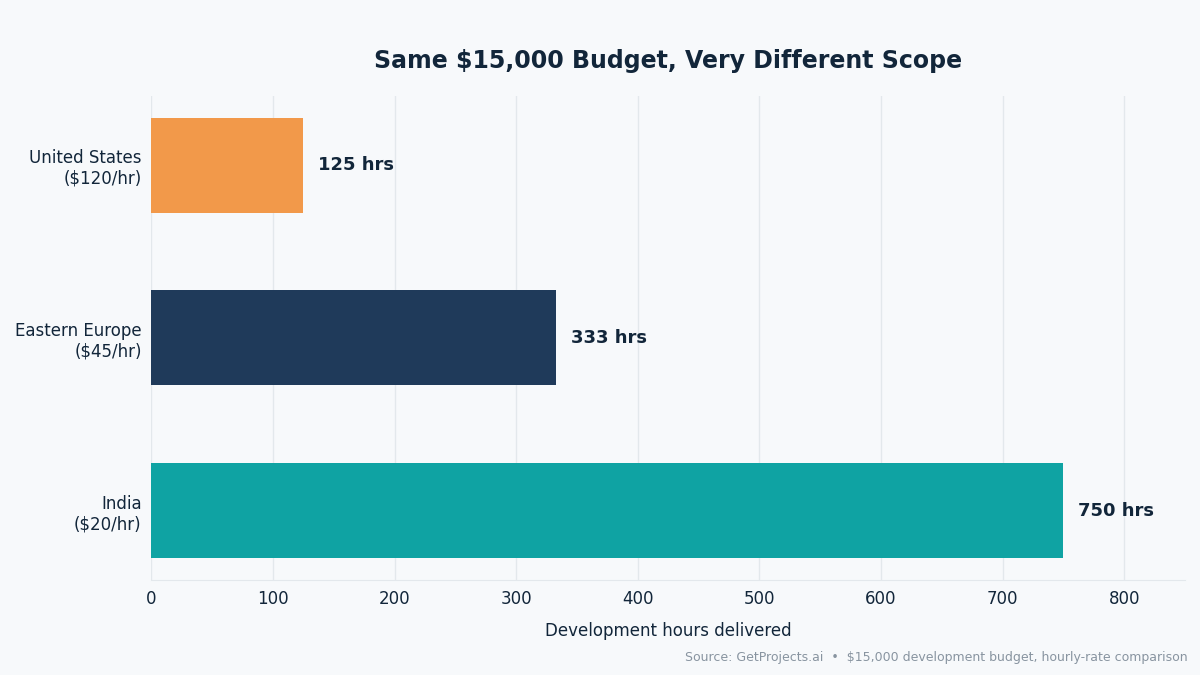
At $15,000 a common startup software budget an Indian team charges $20/hour and delivers 750 hours of development. An Eastern European team at $45/hour delivers 333 hours. A US team at $120/hour delivers 125 hours. These are not the same projects. The scope you can build with 750 hours is 6 times the scope you can build with 125 hours.
Geographic arbitrage in software development is real and well-established. The Fortune 500 has outsourced software development to India and Eastern Europe for 30 years. The quality is not lower, it is different. A developer in Bangalore working for a strong agency has often worked on more complex systems than a developer in Dallas working for a mid-tier firm.
Cost by Project Complexity Tier
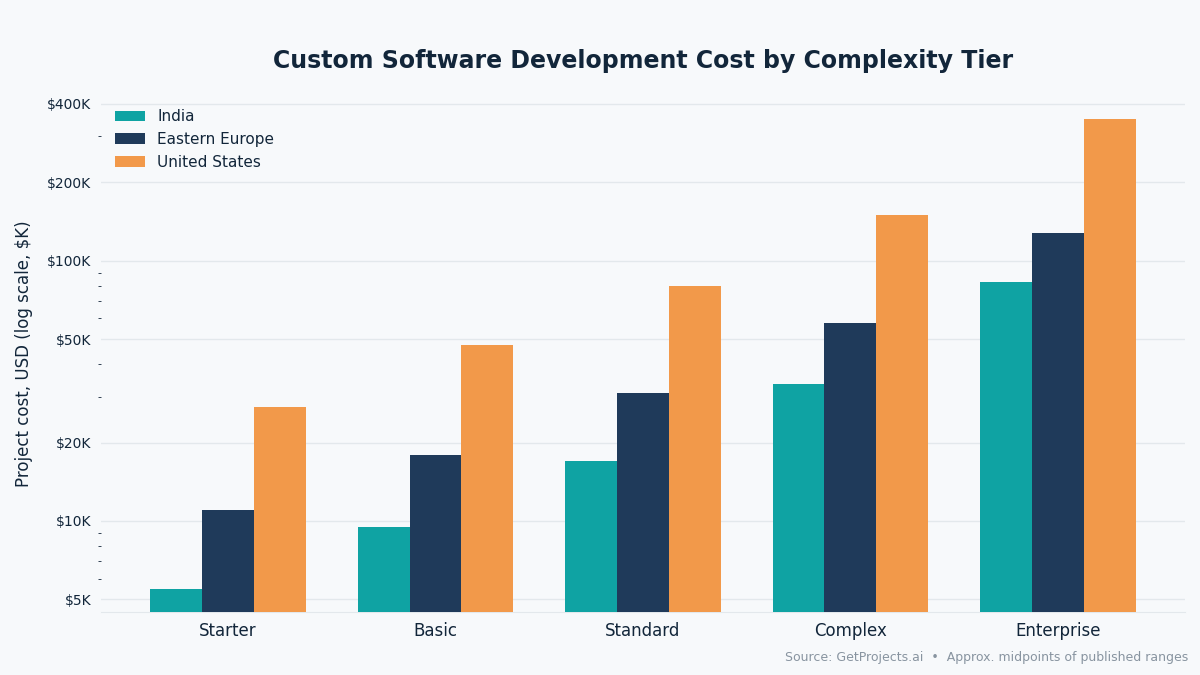
Geography determines the rate. Complexity determines the hours. These two variables together determine the final cost.
The five complexity tiers with realistic cost ranges:
| Tier | Description | Typical Features | India Cost | Eastern Europe Cost | US Cost |
| Starter | Simple app or tool 1 user type, 5–8 screens, basic CRUD | User auth, list views, basic forms, one payment integration | $4K–$7K | $8K–$14K | $20K–$35K |
| Basic | Standard app 2 user types, 10–15 screens, moderate features | User profiles, search, notifications, one integration, admin panel | $7K–$12K | $14K–$22K | $35K–$60K |
| Standard | Solid V1 product multiple user types, 20–35 screens, several integrations | Role-based access, complex forms, 3–4 integrations, reporting | $12K–$22K | $22K–$40K | $60K–$100K |
| Complex | Full-featured platform multiple user types, 40+ screens, complex logic | Real-time features, complex workflows, 5+ integrations, AI features | $22K–$45K | $40K–$75K | $100K–$200K |
| Enterprise | Mission-critical platform compliance, scale, security, integrations | SOC 2, HIPAA, microservices, high availability, 10+ integrations | $45K–$120K | $75K–$180K | $200K–$500K+ |
For most buyers on GetProjects.ai with $5K–$30K budgets, the Starter to Standard tiers with Indian or Eastern European development teams represent the realistic sweet spot of enough budget to build something genuinely useful that real users can engage with.
What Is and Is Not Included in a Typical Agency Quote
This is where projects most commonly exceed their initial budget. The development quote covers one component of the total project cost. There are typically 4 to 6 additional cost categories that buyers do not account for.
The complete cost breakdown:
| Cost Category | Included in Agency Quote? | Typical Cost |
| Development (coding) | Yes core of the quote | The quoted amount |
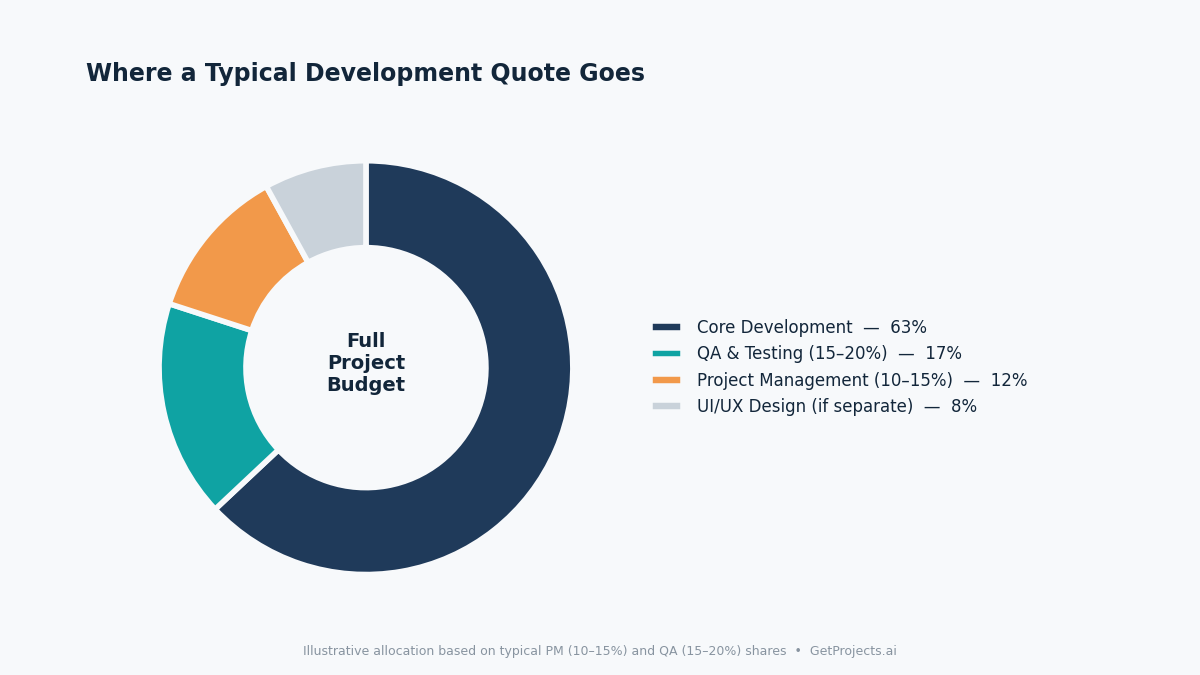
| UI/UX design | Sometimes confirm explicitly | $1,500–$5,000 if separate |
| Project management | Often included, sometimes charged separately | 10–15% of development cost |
| Quality assurance / testing | Often included, sometimes charged separately | 15–20% of development cost |
| Infrastructure setup (AWS, GCP hosting) | Rarely included | $200–$800 for initial setup |
| Monthly hosting and infrastructure | Never included ongoing | $50–$500/month depending on scale |
| Third-party API costs | Never included usage fees | Varies Stripe 2.9%, Twilio SMS per message |
| App Store submission | Sometimes included, sometimes charged separately | $99/year (Apple) + $25 (Google) |
| Post-launch bug fixes | Sometimes included for 30–60 days | Beyond warranty period: $50–$150/hour |
| Future feature development | Never included | New project or ongoing retainer |
The most common budget surprises:
Design is the most frequently underestimated cost. A developer team does not include a designer by default. If your quote does not explicitly mention UI/UX design, you either need to provide your own designs or add a designer to the budget. Expect $2,000 to $4,000 for clean, production-ready designs on a standard mobile or web application.
Infrastructure is the most forgotten cost. Your app needs servers. Those servers cost money every month. A basic production setup on AWS runs $80 to $200 per month for a starter application. At scale 10,000 active users, real-time features, large data storage this increases to $500 to $2,000 per month.
Maintenance is the most underestimated ongoing cost. Software does not stay working without attention. iOS and Android release major updates annually. Library dependencies need updating. Security patches need applying. Budget 10 to 15% of your initial development cost per year for maintenance on a live application.
How to Get the Most Accurate Quote for Your Project
A quote is only as accurate as the brief it is based on. The vaguer your requirements, the wider the range of quotes you will receive and the higher the probability that the winning quote is an underestimate designed to get you started rather than a realistic assessment of what your project will cost.
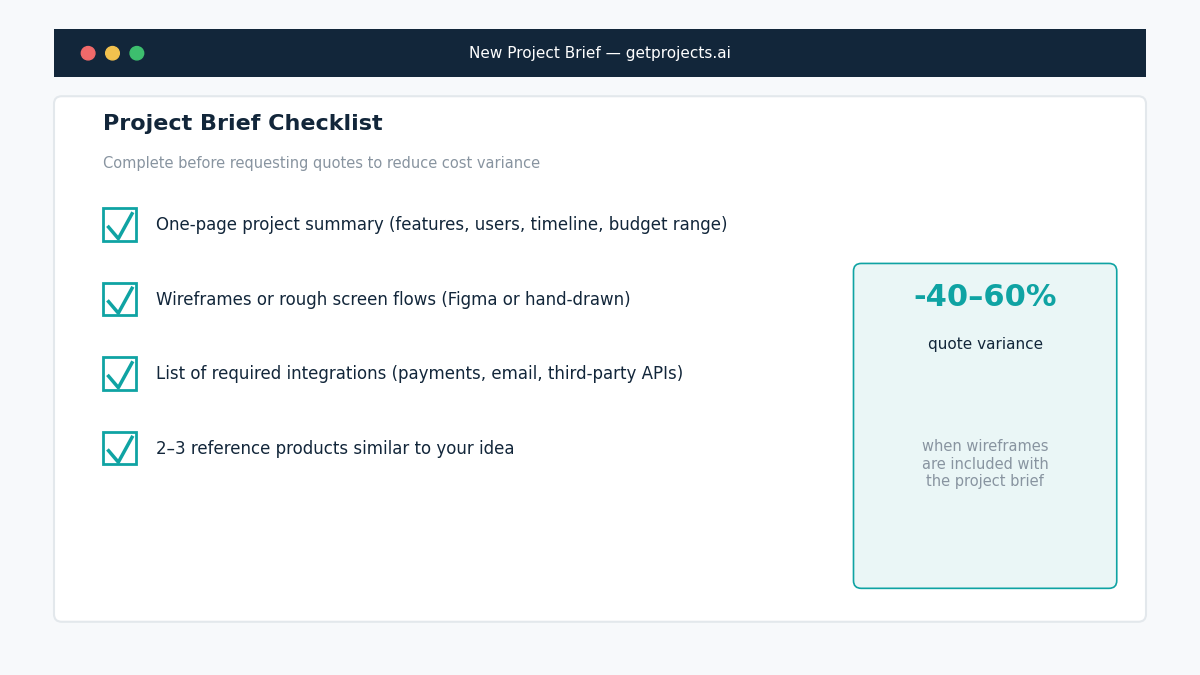
What to prepare before requesting quotes:
A one-page project summary covering: what the product does, who uses it (the user types), what the 5 to 10 most important features are, what technology you prefer or are indifferent to, what your launch timeline is, and what your budget range is. Stating your budget does not get you overcharged; it helps agencies tell you honestly whether they can deliver value at that level.
Wireframes or screen flows, even rough ones drawn in Figma or on paper, reduce quote variance by 40 to 60%. When agencies can see what you are describing rather than imagining it, their time estimates become dramatically more accurate.
A list of integrations you need payment processors, email services, third-party APIs, existing systems your product must connect to. Each integration adds 10 to 40 hours depending on the API quality and documentation.
Reference products 2 to 3 existing apps or websites that represent the kind of product you want to build, even if only approximately. “Like Airbnb but for storage units” is more useful than “a two-sided marketplace with booking and payment.”
Post your project brief on getprojects.ai and receive quotes from agencies who have built similar products. The platform matches your brief with agencies whose portfolios demonstrate relevant experience; you are not getting quotes from agencies who have never built anything in your category.
Frequently Asked Questions
Why do software development costs vary so much between agencies?
The range is driven by three variables: geography (a US developer costs 6 to 8 times an Indian developer per hour), experience level (a senior full-stack developer costs 2 to 3 times a junior developer), and overhead (a 200-person agency with a sales team, account managers, and office space has significantly higher costs than a 10-person boutique). A $5,000 quote and a $25,000 quote for the same project are not usually describing the same product; they are describing different team compositions, different geographies, and different quality expectations. Getting three quotes for the same brief and understanding why they differ is more valuable than accepting the cheapest.
What is the hidden cost most buyers miss when budgeting for custom software?
The most consistently underestimated cost is ongoing maintenance and infrastructure. Most buyers budget for development and launch, then discover that running the application costs $100 to $500 per month in infrastructure, requires periodic updates as mobile operating systems change, and accumulates bugs that need fixing. A well-structured software development contract includes 30 to 60 days of post-launch warranty. After that period, plan for a monthly retainer of $500 to $2,000 with the development agency or an in-house developer who can maintain the codebase. Projects that go dark after launch with no ongoing development partner, no maintenance budget typically require a partial rebuild within 18 to 24 months.
Is it worth paying more for a US-based development company?
For most projects in the $5K–$30K range, the answer is no not because US developers are less capable, but because the math does not work. At $120/hour US rates, $15,000 buys approximately 125 hours of development barely enough for a well-designed single-page application. The same $15,000 with a strong Indian agency at $25/hour buys 600 hours enough for a full-featured MVP. The cases where US rates make sense are: projects requiring in-person collaboration, projects with extremely sensitive IP that must stay onshore, projects requiring compliance with US government contracting rules, and projects where deep domain knowledge specific to the US market (US healthcare regulatory, US financial regulation) is critical to the architecture.
What should I do if my project quote comes in over budget?
Scope reduction is the first and most effective response. Work with the agency to identify the minimum feature set that would allow you to test your core hypothesis with real users. This is the MVP. Features that are “nice to have” for launch but not essential to the product’s core value proposition should be moved to a Phase 2 roadmap. A well-scoped MVP at $10,000 that launches and generates real user feedback is infinitely more valuable than a fully featured product at $40,000 that never ships because funding ran out. The second option is geographic arbitrage. If your original quote was from an Eastern European or US agency, a comparable Indian agency may deliver the same scope at 40 to 60% lower cost.