How to Post a Testing & QA Project and Get Matched With Verified Agencies in 24 Hours
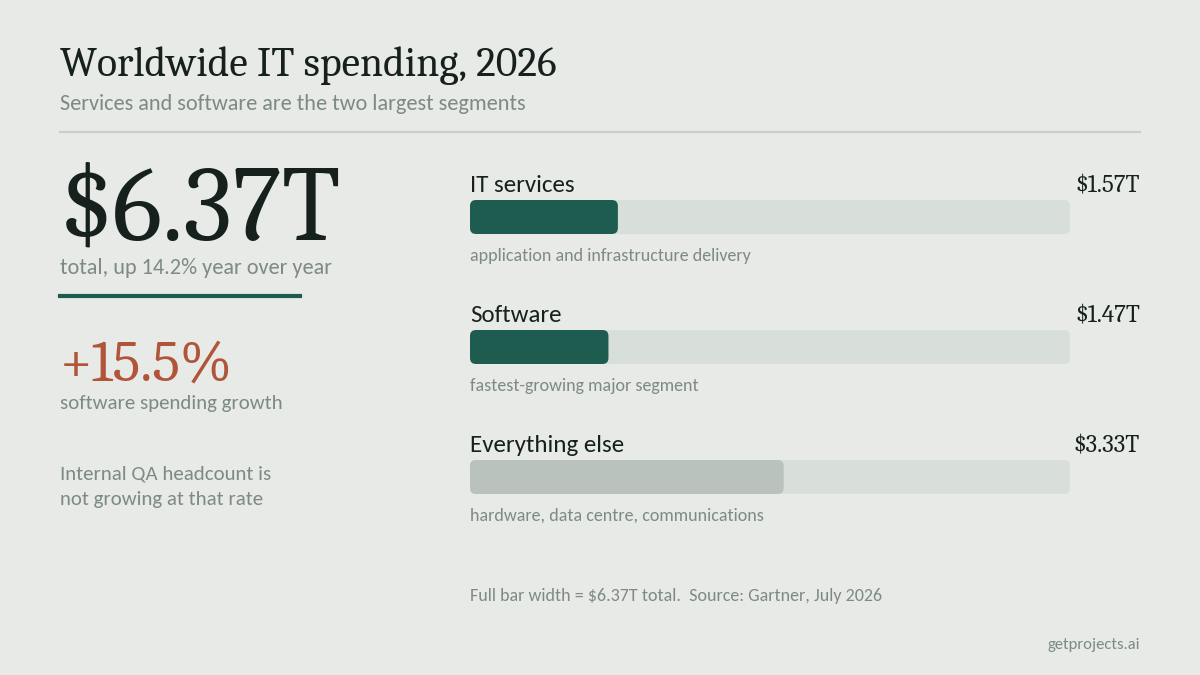
Software spending worldwide is set to rise 15.5% in 2026 to $1.47 trillion, and no engineering organization is growing internal QA headcount at 15.5% to match. That gap is being closed by external testing partners, which moves vendor selection out of the procurement backlog and into the release path. Teams that treat it as paperwork ship late, test thin, or hand quality assurance to whichever agency answered the phone first.
That is why the mechanics of how you post a testing and QA project matter more than most engineering leaders assume. The assumption is that the difficult part of QA outsourcing is finding capable agencies. It isn’t. Competent testing partners operate in every major delivery market, from Pune and Kraków to Austin and Ho Chi Minh City. The difficult part is compression: moving from “we need regression coverage before the March release” to “we have three comparable, credible proposals” without spending five weeks of engineering management time on discovery calls.
Consider two versions of the same cycle. In the first, a CTO emails six agencies found through directories and LinkedIn, waits four to nine days for replies, receives proposals in six incomparable formats, and decides in week five. In the second, the same requirement is submitted once, matched against verified vendors by budget, domain, and delivery history, and returns a shortlist inside a day.
Gartner’s July 2026 forecast puts worldwide IT spending at $6.37 trillion for 2026, up 14.2% year over year, with IT services reaching $1.57 trillion and software $1.47 trillion.
Delivery volume is scaling faster than in-house quality capacity, and the sourcing layer in front of it has not caught up. That is why the way you post a testing and QA project now determines shortlist quality more than the size of your vendor network does.
What It Means to Post a Testing and QA Project Online
To post a testing and qa project is to submit a structured requirement brief QA application type, test scope, platforms, automation needs, timeline, and budget range QA to a marketplace or platform that matches it against pre-verified QA agencies and returns a shortlist of qualified vendors, replacing manual outreach, RFP cycles, and open bidding entirely.
That definition contains three claims worth separating: the brief is structured, the agencies are verified before matching, and the shortlist is finite. Each removes a specific failure mode from traditional vendor selection, which is why teams that post a testing and QA project this way replace outreach volume with match precision.
The Real Bottleneck: QA Vendor Selection Takes Five Weeks, Not Five Days
Vendor-selection cycles for specialized IT services typically run four to seven weeks at mid-market technology companies. For quality assurance specifically, the cycle tends to run at the longer end, because QA scope is harder to describe than a feature build. A client can say “we need a React front end for this Figma file.” Saying “we need enough test coverage that we stop shipping regressions” is a business outcome, not a specification. Ambiguity at that stage is the reason clients who post a testing and QA project with loose scope receive proposals that cannot be meaningfully compared.
Three costs stack up during that delay.
The first is release risk: a team that needs a regression suite before a compliance deadline and spends five weeks shortlisting has burned 35% of a 14-week runway on procurement. The second is engineering time: a CTO or VP Engineering sitting through eight 45-minute discovery calls burns six hours of the most expensive calendar in the company.
The third cost is quieter and larger. When shortlisting drags, teams settle for whichever agency responded fastest rather than the one with the strongest domain match, and defect leakage stays where it was. Rework on a defect found in production runs 6 to 15 times the cost of the same defect caught in a structured test cycle, so a mediocre vendor chooses compounds for the life of the contract.
Bidding marketplaces made this worse rather than better. When a requirement goes live to an open pool, a client receives 20 to 60 proposals within 48 hours. That produces a triage problem, because proposal volume correlates with sales capacity, not testing capability, and the agencies with 14 ISTQB-certified testers are rarely the ones with a dedicated bid-writing team. Clients who post a testing and QA project into an open bid pool are buying triage work, not signal, rather than filtering agencies by service and hourly rate first.
How to Post a Testing and QA Project and Get Matched Inside 24 Hours
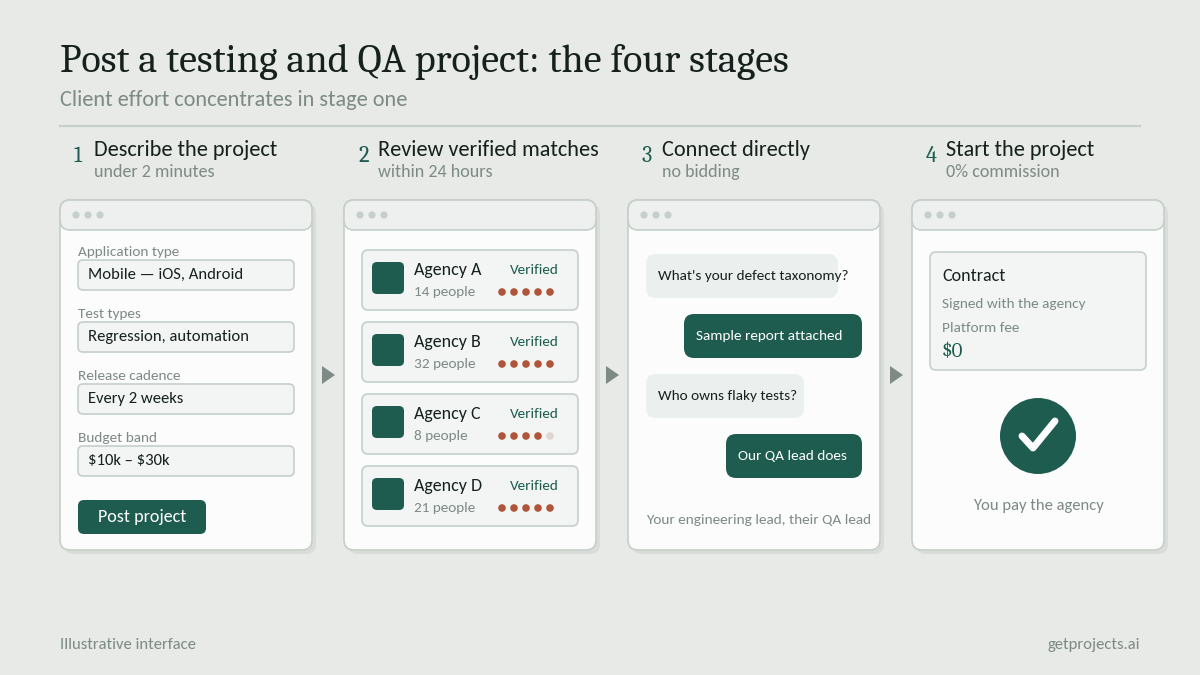
The workflow below is the /clients flow on GetProjects, and it is deliberately shorter than a traditional RFP. There are four stages, the entire client-side effort concentrates on the first one, and together they let a team post a testing and QA project before lunch and hold vendor calls the next morning.
Step 1: Describe the Project (Under Two Minutes)
The intake step is where most requirement documents fail, so the brief-building is AI-assisted. You describe the work in plain language QA “a React Native app on iOS and Android, 180 existing manual test cases, we want an automated regression suite and monthly performance testing” QA and the system structures that into a scoped brief with service categories, platform coverage, timeline, and budget band. Briefs that span build and test also reach app development agencies.
This matters for matching accuracy, not convenience. When you post a testing and QA project with automation scope and platform coverage made explicit, the matching layer can exclude agencies whose portfolios are 90% manual functional testing, which is the single most common mismatch in QA sourcing.
Seven inputs materially change match quality. Include all of them:
- Application type and stack QA web, mobile, API, embedded, or desktop, plus the primary frameworks
- Test types required QA functional, regression, automation, performance and load testing, security testing, accessibility, or cross-browser and device testing
- Current state of QA QA existing test cases, automation coverage percentage, tooling already in place
- Release cadence QA weekly, biweekly, or quarterly, since this determines team model more than headcount does
- Compliance context QA HIPAA, PCI DSS, SOC 2, GDPR, or none
- Engagement model preference QA dedicated team, project-based, or on-demand test cycles
- Budget range and start date QA a band is sufficient; a blank field is not
Step 2: Receive 3–5 Verified Agency Matches Within 24 Hours
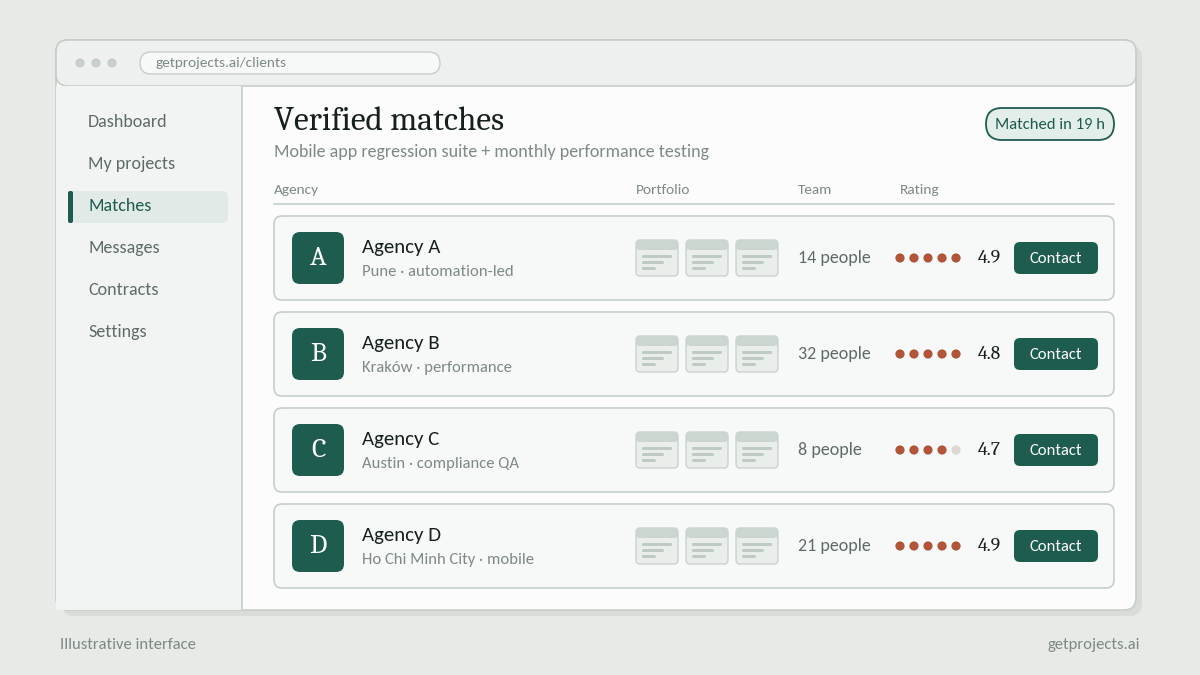
Matching runs against 50+ data points including budget fit, domain expertise, client history, and past performance, and returns a shortlist rather than an inbox. Each match arrives with portfolio work, team size, ratings, and comparable past projects attached, which is what lets you post a testing and QA project on Monday and hold substantive conversations on Tuesday.
Three to five is not an arbitrary cap. Decision quality peaks at three to five comparable options and degrades past seven, as evaluation shifts from comparison to elimination. A finite shortlist also changes agency behavior: a vendor competing against four named peers invests in a real scoping conversation, while a vendor competing against 40 sends a template.
Step 3: Connect Directly, With No Bidding
Once matches arrive, you contact agencies directly. There is no intermediary rewriting your requirement, no platform account manager brokering the relationship, and no bid window. The practical effect is that technical conversations happen between the people who will actually run the engagement: your engineering lead and their QA lead, not two business development teams. This is the payoff of the earlier steps: you post a testing and QA project once, and every conversation that follows is technical rather than transactional.
This is where you find verified testing and QA agencies worth a second call. Ask each shortlisted vendor for a sample defect report from a comparable project, their defect taxonomy, and how they measure escaped defects. Agencies with mature test case management practices answer in minutes. Agencies without them pivot to discussing headcount and hourly rates.
Step 4: Start the Project With Zero Commission
When you select an agency, you contract and pay that agency directly. No percentage of the engagement value is deducted, which distinguishes this model from commission-based marketplaces that take 10–20% of project value, and from directory platforms charging agencies $499+ per year for placement.
The commission structure is not just a pricing detail; it shapes who you see. On a platform taking 15%, agency margins absorb the cut, and the vendors most willing to accept that hit are typically those with the weakest direct pipeline. Removing the commission removes that adverse selection, and it is why the cost to post a testing and QA project stays at zero on the client side. Agency listings are free as well.
What “Verified” Should Actually Mean
The word gets used loosely. A meaningful verification process operates in layers before any profile goes live: website and domain ownership, business email verification, review authenticity, and team detail confirmation, combined with automated checks and manual review. That layered approach is what separates a verified agency network from a self-service listing directory where anyone with a landing page appears alongside a 60-person testing firm.
When you evaluate any platform, ask what specifically was verified. “Verified” that means “confirmed the email address exists” is not the same as “confirmed a registered entity, a real team, and attributable client work.” Anyone can post a testing and QA project quickly; the verification layer is what makes the resulting matches worth a call.
Cost Implications: What QA Engagements Actually Run
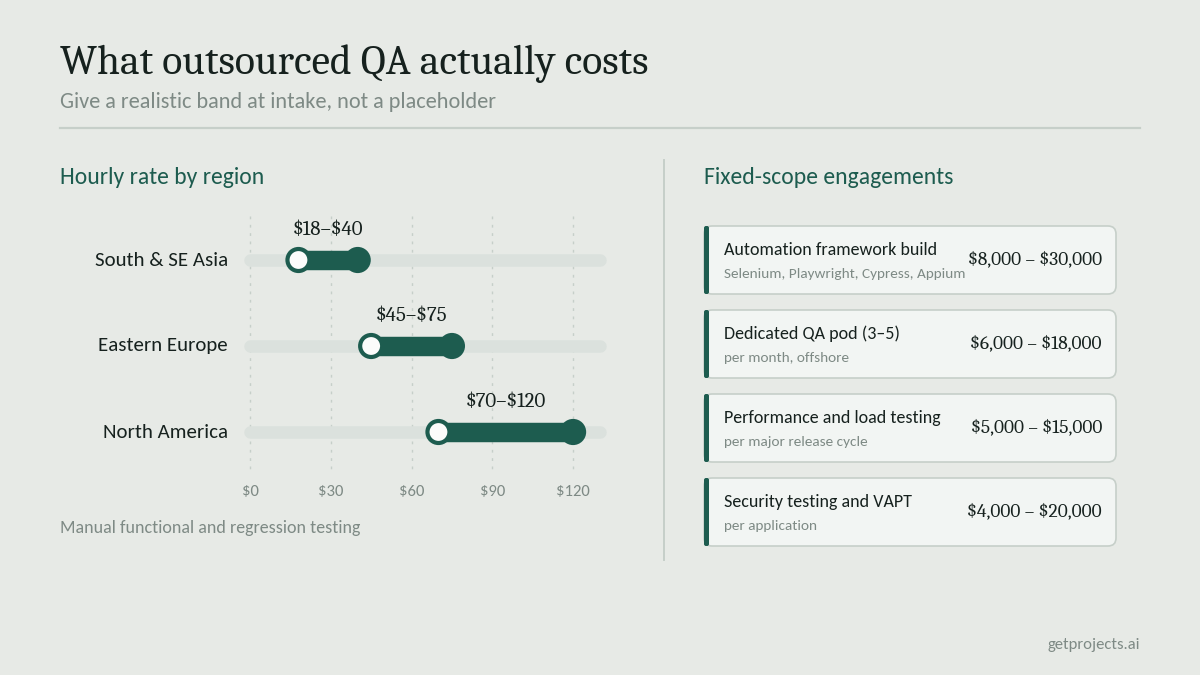
Budget bands help matching only if they are realistic. Current market ranges for outsourced QA work:
- Manual functional and regression testing: $18–$40 per hour in South and Southeast Asia, $45–$75 in Eastern Europe, $70–$120 in North America
- Test automation framework setup (Selenium, Playwright, Cypress, Appium): $8,000–$30,000 as a fixed-scope project, depending on suite size
- Dedicated QA pod of 3–5 engineers: $6,000–$18,000 per month offshore
- Performance and load testing engagement: $5,000–$15,000 per major release cycle
- Security testing and VAPT: $4,000–$20,000 per application
A team that budgets $10,000 for a full automation build across web and two mobile platforms will still get matched, but with agencies scoping to the budget rather than the requirement. Accuracy at intake protects you from that, so give a realistic band rather than a placeholder number when you post a testing and QA project with scope still in flux. Rates by city are visible on pages like agencies in Pune.
Real-World Application: Two Sourcing Cycles Compressed
The compression is measurable. Two recent sourcing cycles show what changes when teams post a testing and QA project as a structured brief instead of an email thread.
A Series B payments company in Singapore needed regression and performance testing coverage before migrating payment rails. Its internal RFP had been open for four weeks and produced two usable responses. The requirement was resubmitted as a structured brief, returned four verified matches in 19 hours, and the selected agency delivered an automated regression suite that cut pre-release testing from six days to under 11 hours across a nine-week, $28,000 engagement.
A US healthcare SaaS company with 240 manual test cases and a three-week release cycle needed QA partners familiar with HIPAA-adjacent workflows. Three matches arrived the following day; the chosen vendor deployed a 12-person team and moved the product to biweekly releases within four months. On the $180,000 18-month contract value, a commission-based marketplace at 12% would have added roughly $21,600 in platform fees.
Comparison Framework: Four Ways to Source a QA Partner
Before you submit testing and QA requirements online anywhere, it is worth knowing what each sourcing model optimizes for.
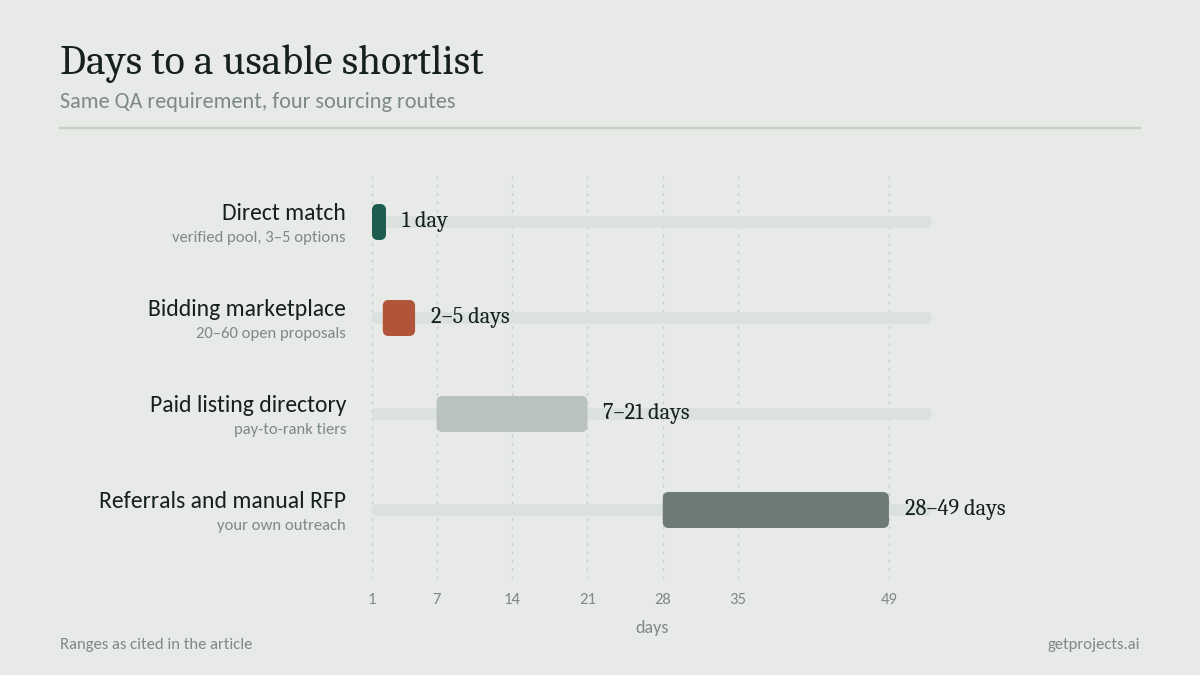
| Sourcing model | Time to usable shortlist | Cost to client | Vetting depth | Vendor incentive |
| Direct-match marketplace | 24 hours | $0, no commission | Layered pre-verification | Win on capability fit |
| Bidding marketplace | 2–5 days, 20–60 bids | 10–20% commission | Minimal or self-declared | Win on price and speed of bid |
| Paid listing directory | 1–3 weeks | Free to browse; $499+/yr for agencies | Pay-to-rank in most tiers | Win on listing spend |
| Referrals and manual RFP | 4–7 weeks | Free but high internal cost | Whatever you do yourself | Win on relationship |
Referrals produce the highest trust and the worst coverage: your network’s QA vendors are a sample of convenience. Bidding platforms produce the most options and the worst signal. Direct matching sits between them, which is the reason clients who need to get testing and qa quotes fast without a triage problem tend to prefer it. Decide the model before you post a testing and QA project anywhere, and apply the same logic to web development agencies.
What Most Teams Get Wrong When Hiring a QA Agency
Four patterns show up repeatedly in failed QA engagements, and none of them are about price.
They brief for headcount instead of outcomes. “We need three testers” is a staffing request. “We need escaped defects below two per release and a regression cycle under four hours” is a specification an agency can be held to. The first framing guarantees you will evaluate vendors on rate cards, which is the least predictive variable available. Write the target outcome into the brief before you post a testing and QA project.
They over-weight tooling logos. An agency listing Selenium, Cypress, Playwright, JMeter, Appium, and Postman on its profile has told you almost nothing. Ask instead how many of its current engagements maintain a suite of more than 500 automated test cases, and who owns flaky-test remediation. Tool familiarity is abundant; framework maintenance discipline is not.
They treat the lowest hourly rate as the lowest cost. A $20-per-hour team that produces 40% flaky tests and misses two production defects per quarter is more expensive than a $45-per-hour team that does not. Defect leakage is the real unit of cost, and it belongs in the contract as a measured metric.
They interview sequentially. Teams that talk to one agency, then the next, lose comparability; by the third call the criteria have drifted. Run all shortlisted conversations inside the same week, with the same five questions, and score them before anyone sends a proposal. The ability to hire testing and QA companies free of platform fees is only useful if the evaluation itself is disciplined.
Start With a Brief, Not a Vendor List
If you are scoping QA work for a release deadline and want to compare verified agencies without paying commissions, bidding blind, or spending five weeks on discovery calls, the fastest path is to post testing and QA projects online as a structured brief and let the matching narrow the field for you.
Describe the requirement in under two minutes, review 3–5 verified matches within 24 hours, and talk to as many of them as you need before committing to anyone. It takes roughly as long to post a testing and QA project as it does to write the email you were going to send to your first vendor. Posting costs nothing; you contract with the agency directly.
Start Your Project QA post a testing and QA project on GetProjects and get matched with verified QA agencies in 24 hours.
Frequently Asked Questions
Is it free to post a testing and QA project?
Yes, entirely. There are no listing fees and no charge to connect with matched agencies when you post a testing and QA project. You pay only the agency you hire, directly, at the rate you negotiate with them. There is no commission deducted from the engagement value, which means the quoted project cost is the actual project cost.
How long does it take to get matched with verified testing and QA agencies?
Matches typically arrive within 24 hours of submission, and the brief itself takes under two minutes to complete. The time is spent on matching against budget, expertise, and delivery history rather than on waiting for bids to accumulate. Most clients who post a testing and QA project in the morning are holding vendor calls the following day, and briefs with clear automation scope return sharper shortlists.
How are testing and QA agencies verified?
Verification runs in layers before a profile becomes visible: website ownership, business email domain, review authenticity, and team details, using automated checks combined with manual review. The purpose is to remove single-person operations presenting as delivery teams from the pool before they reach a client shortlist.
Can I talk to multiple agencies before choosing one?
Yes, and you should. The recommended approach is to speak with every agency on your shortlist, ask each the same technical questions, and request a sample test report and defect taxonomy from a comparable project. There is no exclusivity requirement and no obligation to hire any matched agency.
How much does hiring a testing and QA agency cost?
Outsourced QA rates range from roughly $18 to $120 per hour depending on region and specialization, with fixed-scope automation builds between $8,000 and $30,000 and dedicated offshore QA pods between $6,000 and $18,000 per month.
What should a QA requirement document include?
At minimum: application type and stack, required test types, current QA maturity and existing coverage, release cadence, compliance obligations, preferred engagement model, budget band, and start date. If any are undefined, state the uncertainty rather than leaving the field blank; matching handles a stated range better than a gap.
What is the difference between direct matching and a bidding platform?
Bidding platforms broadcast your requirement to an open pool and typically deduct 10–20% of project value. Direct matching filters a verified pool against your brief, returns three to five options, and takes no percentage. The distinction shows up most clearly in shortlist quality: fewer, better-fit responses instead of high proposal volume. The practical test is to count how many usable conversations follow when you post a testing and QA project through each model.