Best AI Development Companies in 2026 How to Find the Right One for Your Budget
Every software development agency in 2026 has “AI” somewhere on their homepage. Most of them mean they can integrate an OpenAI API call into an existing application. A small number of them can actually build production-grade AI systems, custom models, RAG pipelines, multi-agent architectures, fine-tuned LLMs, computer vision systems that solve real business problems at production scale.
That’s why choosing the best AI development companies requires more than checking portfolios; it means evaluating actual experience with models, data pipelines, and real-world deployment.
According to Statista AI Market Insights, the global AI market is projected to exceed $305 billion in 2026, driven by rapid adoption across startups and enterprises. Yet only a limited number of agencies can deliver reliable AI solutions within practical budgets.
The AI development market grew at 35% in 2025 and is projected to cross $150 billion by 2030. The demand from startups and mid-market companies wanting to build AI-powered products has never been higher. The supply of agencies genuinely capable of delivering them at the $5K to $30K budget range that most first-time AI buyers operate in is far smaller than the number of agencies claiming the capability.
This guide covers what separates real AI development capability from marketing language, how to evaluate agencies at the $5K–$30K budget level, and how to structure your project to get genuine value from an AI build.
What “AI Development” Actually Means in 2026
The term AI development covers a spectrum of technical complexity so wide that two agencies describing themselves identically may be offering completely different services.
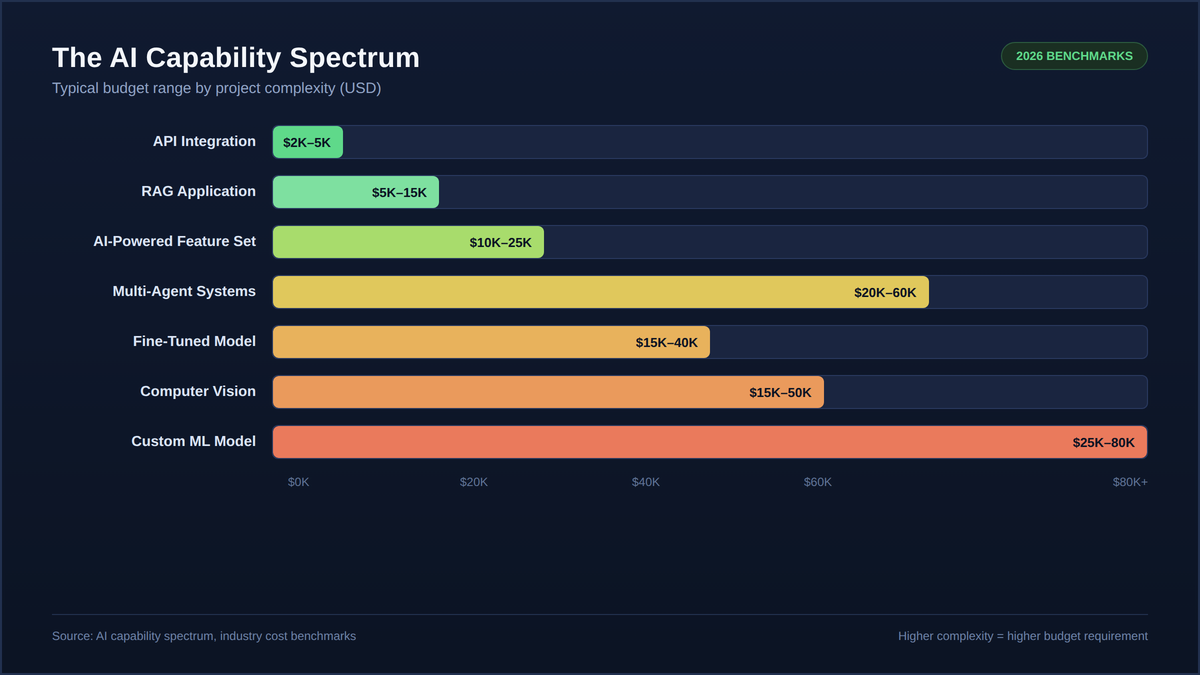
The AI capability spectrum:
| Level | What It Involves | Who Can Do It | Budget Range |
| API integration | Calling OpenAI/Anthropic/Gemini API from existing app | Any competent web developer | $2K–$5K |
| RAG application | Vector database + document chunking + LLM orchestration | Developers with LLM app experience | $5K–$15K |
| AI-powered feature set | Multiple AI features in a product search, recommendations, summarisation, generation | Agencies with 5+ production AI deployments | $10K–$25K |
| Fine-tuned model | Customising a base model on domain-specific data | Agencies with ML engineering capability | $15K–$40K |
| Custom ML model | Training models from scratch or from open-source base | Teams with data scientists and ML engineers | $25K–$80K |
| Multi-agent systems | LLM orchestration with tools, memory, planning | Senior AI engineering teams | $20K–$60K |
| Computer vision | Image classification, object detection, OCR at production scale | Specialised CV teams | $15K–$50K |
For the $5K–$30K budget range, the realistic deliverables are API integration, RAG applications, and AI-powered feature sets. Fine-tuning and custom model training at this budget is possible only with Indian or Southeast Asian teams and a well-scoped project.
Understanding which level of AI capability your project actually needs is the most important question to answer before starting an agency search. Most business problems that seem to require custom AI models can actually be solved with well-architected RAG or API-integration solutions at a fraction of the cost.
What Makes a Genuine AI Development Agency
The difference between an agency that can do AI and one that claims to do AI is measurable. You do not need to be a machine learning engineer to spot it.
The signals of genuine AI capability:
| Signal | What to Look For | Red Flag |
| Production AI portfolio | Live products that use AI features you can actually use and test | AI portfolio consisting of prototypes, demos, and slide decks |
| Specific model experience | They can tell you which models they have worked with, at what scale, and what the accuracy or performance outcomes were | Vague references to “AI and machine learning” without specifics |
| RAG architecture knowledge | Can explain retrieval-augmented generation, vector databases, chunking strategies, and embedding models without prompting | Calls every AI application a “chatbot” |
| Data handling capability | Can describe how they have handled training data, evaluation datasets, and model validation | No mention of data when discussing AI projects |
| Evaluation methodology | Can explain how they measure whether an AI feature is performing well not just “it works” but precision, recall, hallucination rate, latency | No discussion of how AI performance is measured |
| Framework familiarity | LangChain, LlamaIndex, Hugging Face, PyTorch, FastAPI recent, relevant experience | References to outdated frameworks or no specific framework experience |
The interview test:
Ask the agency to describe the architecture of an AI feature they built in the last 12 months. A genuinely capable AI team can walk you through: the data flow, the model they used, why they chose it over alternatives, what the prompt engineering looked like, how they evaluated performance, and what they would do differently.
An agency pretending to have AI capability will give you a vague answer about “training AI on your data” without any architectural specifics.
Types of AI Projects at the $5K–$30K Range
Most AI projects in this budget range fall into one of five categories. Understanding which one you are building helps you find the right specialist.
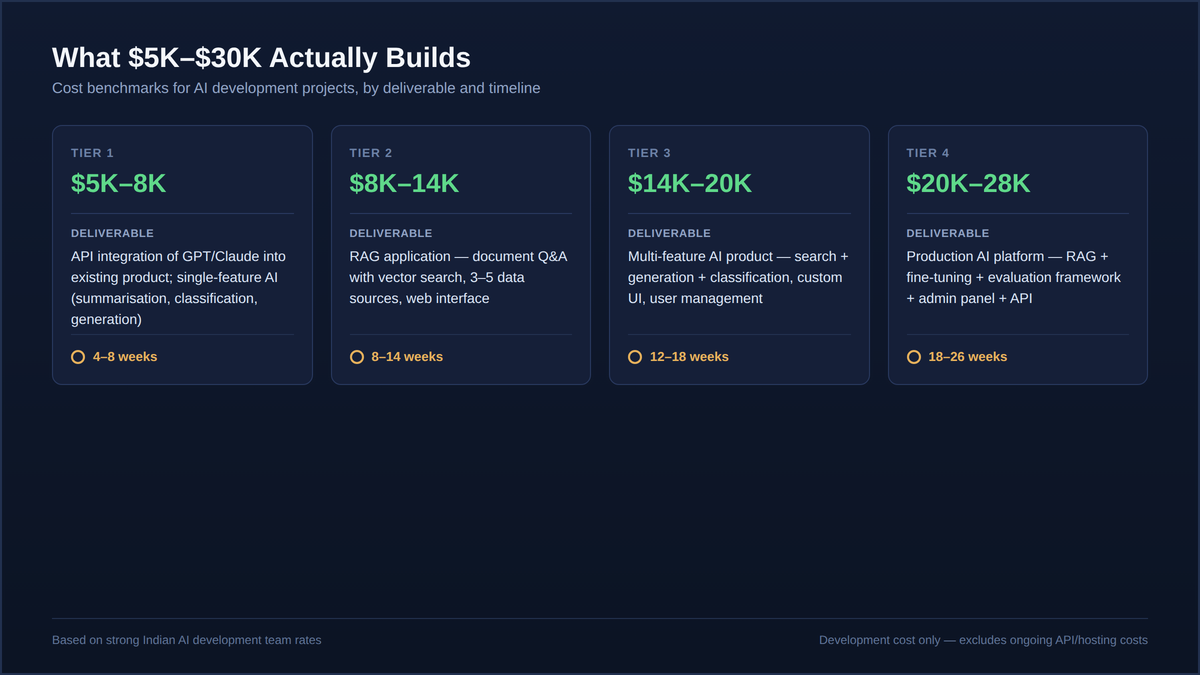
The five common AI project types at startup and SME budget levels:
| Project Type | What It Is | Example | Budget Range (India) | Budget Range (Eastern Europe) |
| AI-powered search | Semantic search over documents or product catalogue | Legal document search, product discovery | $6K–$12K | $12K–$22K |
| Document Q&A / RAG | LLM that answers questions from your documents | Internal knowledge base, contract assistant | $7K–$14K | $14K–$25K |
| Content generation tool | AI that generates structured content from templates or data | Product descriptions, personalised emails, report generation | $5K–$10K | $10K–$18K |
| AI classification / categorisation | ML model that categorises or tags inputs | Support ticket routing, product categorisation, sentiment analysis | $8K–$15K | $15K–$28K |
| Computer vision feature | Image analysis integrated into a product | Damage detection, product recognition, document extraction | $10K–$20K | $20K–$40K |
Each category has a different technical profile, different frameworks, different data requirements, and different evaluation approaches. The agency you hire should have specific experience in your category, not general AI experience.
The Generative AI Distinction What LLM Development Requires
The majority of new AI projects at the $5K–$30K budget level involve large language models GPT-4o, Claude, Gemini, or open-source models like Llama 3. Building LLM-powered applications is categorically different from classical ML development.
What LLM application development actually involves:
Prompt engineering is not just writing a prompt. Production prompt engineering involves structured prompting techniques (chain-of-thought, few-shot examples, system prompts), prompt version management, testing prompt variations systematically, and handling edge cases where the model produces unreliable output. This is a genuine engineering discipline.
RAG architecture is the most important skill for AI applications that need to work with your data. Most AI business applications need to answer questions about or generate content from a specific corpus of company documents, product catalogues, customer data, code repositories. RAG (Retrieval Augmented Generation) is the architecture that enables this reliably without hallucination.
Building a production RAG system requires: document chunking strategy, embedding model selection, vector database setup (Pinecone, Qdrant, pgvector), retrieval ranking, and generation with citation. This is a 2 to 4 week build at the application layer.
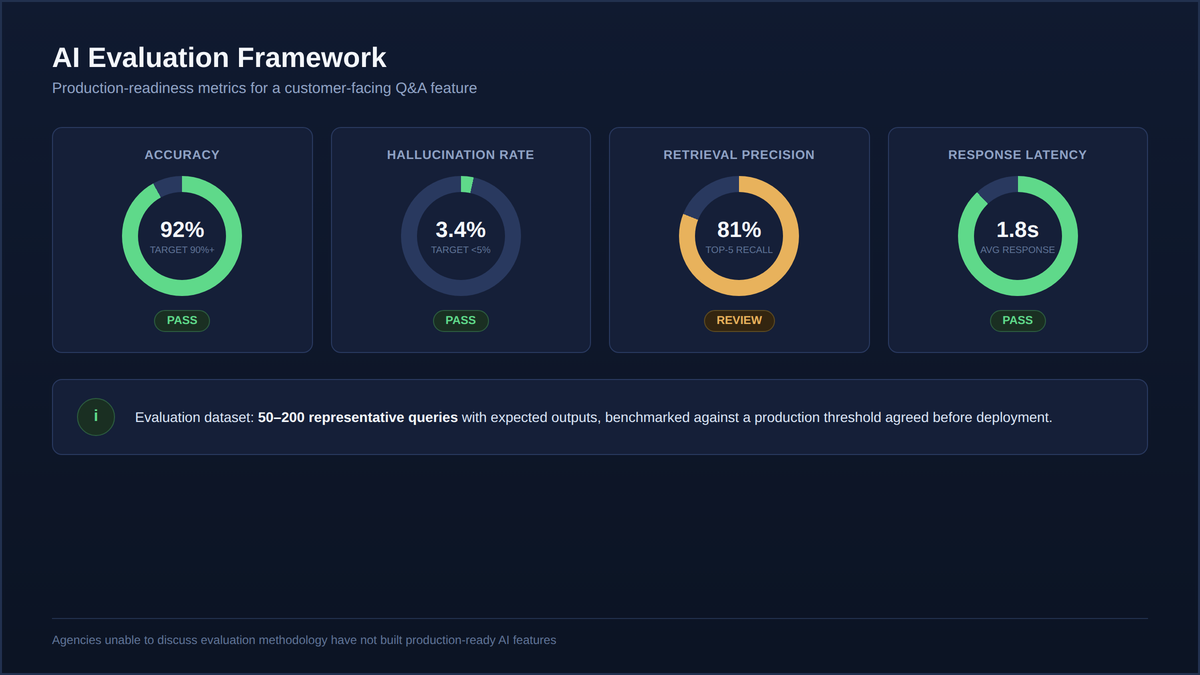
Evaluation is what separates prototype AI applications from production AI applications. A demo that works 80% of the time looks impressive. A production system that fails 20% of the time on user queries is a reliability problem.
Genuine AI development agencies build evaluation frameworks test sets of representative queries with expected outputs and measure model performance against them before deployment.
The LLM cost structure:
| Cost Component | Range | Notes |
| Development (agency fees) | $5K–$25K | The primary cost |
| LLM API costs (OpenAI/Anthropic) | $50–$500/month for typical app scale | Scales with usage |
| Vector database hosting | $50–$200/month | Pinecone, Qdrant managed |
| Embedding generation (one-time) | $10–$100 for initial corpus | Depends on document size |
| Model fine-tuning (if required) | $200–$2,000 for compute | OpenAI fine-tuning or self-hosted |
LLM API costs are operating costs, not development costs. A buyer with a $10,000 development budget should separately budget $100 to $300 per month for ongoing API costs.
Cost Benchmarks AI Development at $5K–$30K
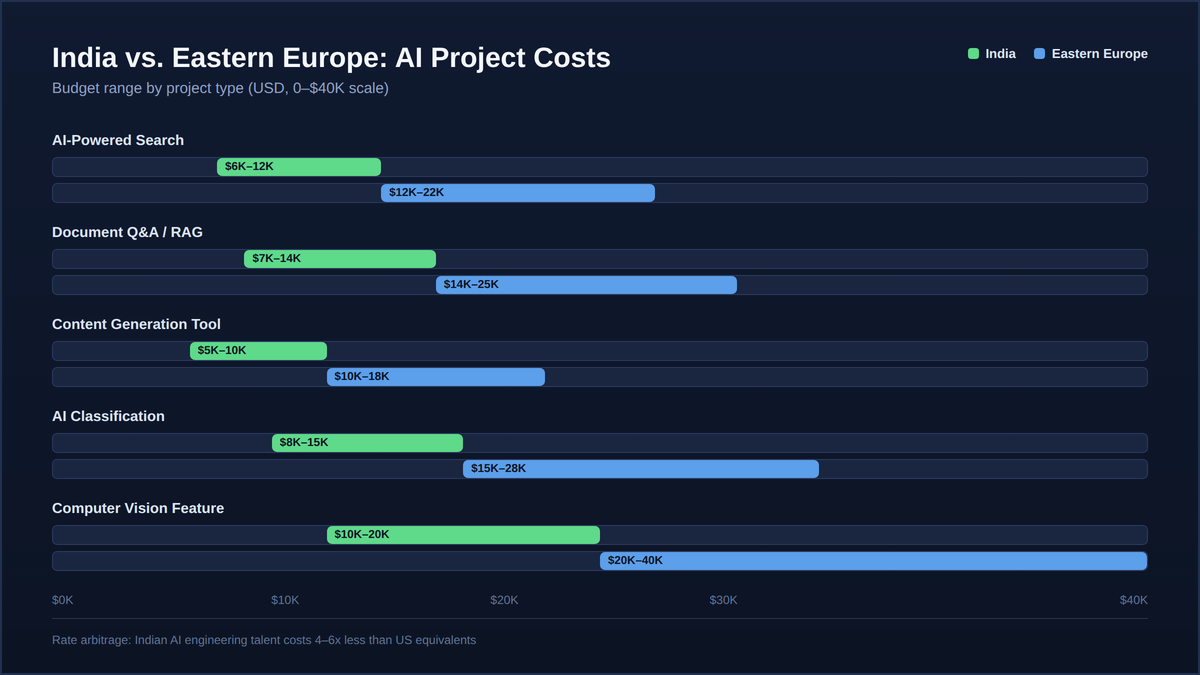
What your budget realistically builds with a strong Indian AI development team:
| Budget | Deliverable | Timeline |
| $5K–$8K | API integration of GPT/Claude into existing product, single-feature AI (summarisation, classification, generation) | 4–8 weeks |
| $8K–$14K | RAG application document Q&A with vector search, 3–5 data sources, web interface | 8–14 weeks |
| $14K–$20K | Multi-feature AI product search + generation + classification, custom UI, user management | 12–18 weeks |
| $20K–$28K | Production AI platform RAG + fine-tuning + evaluation framework + admin panel + API | 18–26 weeks |
Why Indian AI agencies represent the strongest value at this budget:
India’s AI talent concentration is significant and growing. IIT and IISc graduates who chose AI research careers are now building product companies and consulting agencies. The country has deep talent in Python, PyTorch, TensorFlow, and the LLM application stack (LangChain, LlamaIndex, Hugging Face) at rates that are 4 to 6 times lower than US equivalents. This same talent depth is why India consistently ranks among the top destinations when businesses compare software development companies for technical execution, not just AI.
An AI developer in Bangalore with 3 years of production ML experience costs an agency $18,000 to $28,000 per year in salary. The equivalent in San Francisco costs $180,000 to $220,000. This structural difference produces the rate arbitrage that makes Indian AI agencies compelling for $5K–$30K buyers. If you’re weighing this rate arbitrage against your own hiring process.
Red Flags Specific to AI Development Agencies
Beyond the universal red flags, AI development has specific patterns worth knowing. If you haven’t yet, it’s worth reviewing how to hire a software development company first, since the general vetting principles still apply before you layer AI-specific scrutiny on top.
An agency that proposes “training a custom AI model on your data” for a $8,000 project has not thought about what model training actually requires. A meaningful custom model requires a dataset with thousands to millions of labelled examples, compute resources, and evaluation infrastructure.
For $8,000, you are not training a meaningful custom model, you are API-integrating or fine-tuning at best. An agency that promises training without understanding this constraint is setting you up for failure.
An agency that builds AI prototypes exclusively with impressive demos that work with curated inputs and break on real-world inputs without production deployment experience is optimising for the pitch, not the product.
Ask specifically: have you deployed an AI feature to production and monitored it for more than 3 months? What failure modes did you discover after launch that were not visible in testing?
An agency that cannot explain how it handles AI hallucination for your use case is not ready for production AI development. For every LLM-powered feature, there are hallucination risk cases where the model confidently produces wrong output.
Production-grade AI development requires specific mitigation strategies appropriate to your use case: retrieval grounding, output validation, human review workflows, or confidence thresholds.
If the agency has no answer to “how will you prevent hallucination in my product?”, they have not thought through production requirements.
Frequently Asked Questions
What is the difference between AI development and ML development?
Machine learning (ML) development involves training statistical models on data to make predictions or classifications, a fraud detection model trained on transaction data, a recommendation engine trained on user behaviour, an image classifier trained on labelled images. It requires data engineering, feature engineering, model training, and evaluation infrastructure. AI development is a broader term that includes ML but also encompasses rule-based systems, large language model applications, and computer vision systems. In 2026, most new AI projects at the startup and SME budget level involve large language models (generative AI) rather than classical ML because LLM-based applications can often be built without training data, using pre-trained models as the intelligence layer. The distinction matters when evaluating agencies: a team with classical ML experience (Python, Scikit-learn, XGBoost) is not automatically qualified for LLM application development (prompt engineering, RAG, LangChain), and vice versa.
How much data do I need to build an AI-powered product?
For LLM-powered applications the most common category at $5K–$30K budgets you do not need training data at all. GPT-4o, Claude, and Gemini come pre-trained on a vast corpora. You need your domain-specific documents for RAG (a few hundred to a few thousand pages is sufficient for most business applications) and a test set of 50 to 200 representative queries with expected outputs for evaluation. For classical ML applications classification, recommendation, prediction you typically need a minimum of 1,000 to 10,000 labelled examples to train a useful model, and more is always better. If you do not have this data, your first project should be building the data collection infrastructure, not the ML model.
Is it worth building a custom AI model or should I use a pre-trained model like GPT-4o?
For the vast majority of $5K–$30K AI projects, use a pre-trained model. Custom model training is expensive, slow, requires significant data, and produces results that often do not outperform well-prompted pre-trained models for most business use cases. The cases where custom training is genuinely worth it are: highly specialised domains where pre-trained models have limited knowledge (rare medical conditions, proprietary industrial processes), applications requiring extremely low latency where API calls are too slow, applications with strict data privacy requirements where sending data to a third-party API is prohibited, and applications at scale where API costs exceed the training amortisation cost. For a first AI product at startup budget, start with pre-trained models and build custom training into your roadmap only after you have validated that the pre-trained approach has meaningful limitations for your specific use case.
How do I evaluate whether an AI feature is working well enough for production?
Define an evaluation dataset before development begins a set of 50 to 200 representative inputs with the expected correct outputs. This dataset becomes the benchmark against which the AI feature is measured. Common metrics depending on the feature type: for classification tasks, measure precision and recall; for generation tasks, measure factual accuracy against the source documents and hallucination rate; for retrieval tasks, measure whether the correct documents were retrieved in the top-5 results. A production threshold the minimum acceptable performance on your evaluation dataset should be agreed between you and the agency before deployment. For a customer-facing Q&A feature, an acceptable threshold might be 90%+ correct answers on your evaluation set and less than 5% hallucinated answers. Agencies that cannot discuss evaluation methodology and thresholds have not built AI features that work reliably in production.